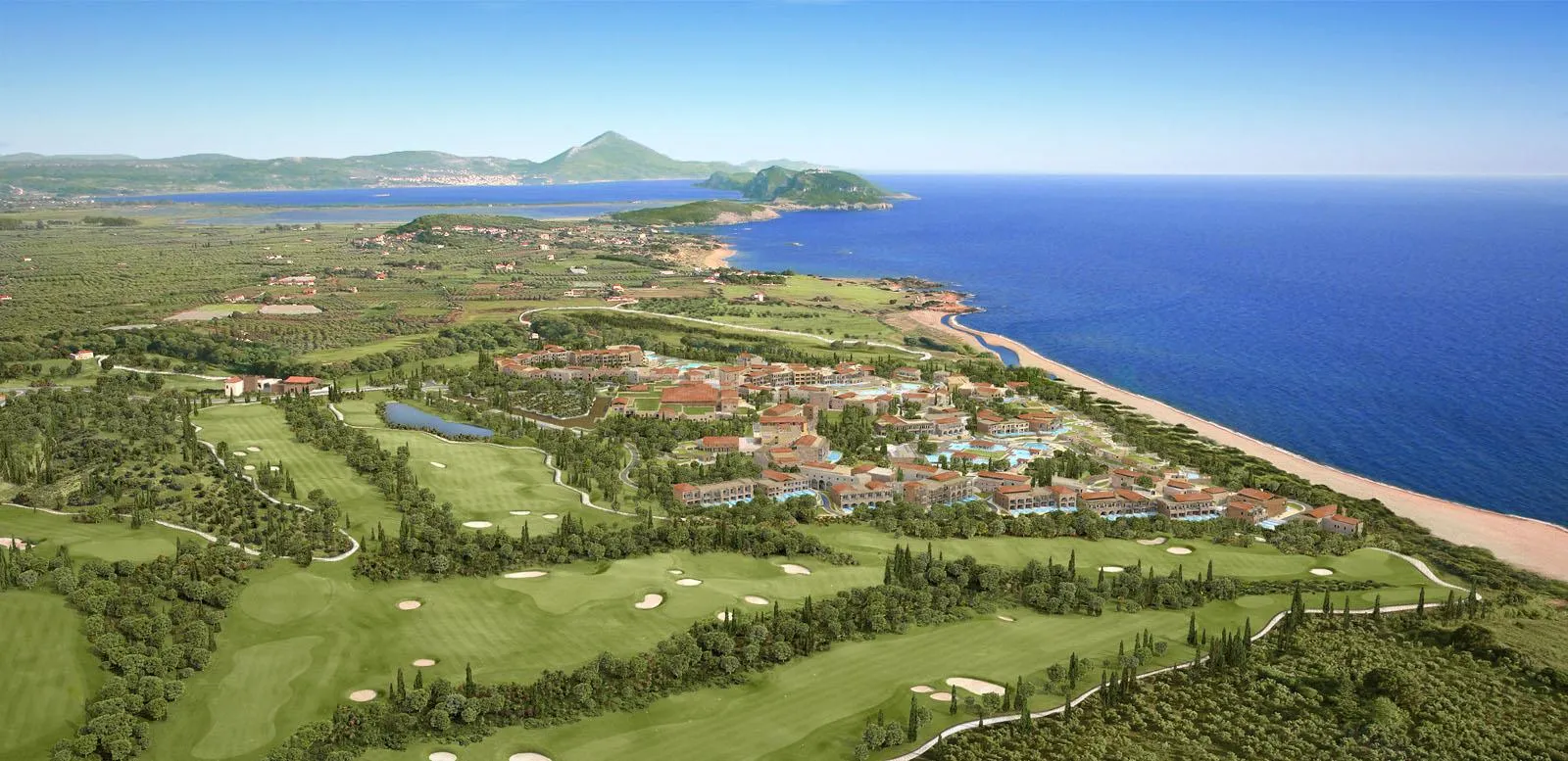
Pylos – Costa Navarino Resort
Pylos is a small town on the southern edge of Navarino Bay, in the south-west corner of the Peloponnese. It is one of the finest natural harbours in Greece — a wide basin almost closed off by the island of Sphacteria — and that geography has drawn fleets, sieges and settlements to it for three thousand years. The Costa Navarino resorts sit along the coast a short drive north, and the same short drive reaches the best-preserved Mycenaean palace in Greece and one of the most photographed beaches in the country.
Pylos and Costa Navarino are among our private transfer destinations from Athens, the airport and Piraeus.
See transfer route from Athens Airport to Pylos/ Costa Navarino →
Navarino Bay
The bay is enclosed by the long thin island of Sphacteria, leaving two narrow entrances. It has been decisive twice.
In 425 BC, during the Peloponnesian War, an Athenian force trapped a body of Spartan hoplites on Sphacteria and forced them to surrender — an outcome that astonished the Greek world, because Spartans were not expected to surrender under any circumstances.
On 20 October 1827, a combined British, French and Russian fleet under Admiral Codrington destroyed the Ottoman and Egyptian fleet anchored inside the bay. It was the last major naval battle fought entirely under sail, and it effectively secured Greek independence. The wrecks are still on the bottom of the bay.
Niokastro and Paleokastro
Two fortresses guard the two entrances.
Niokastro, the “new castle”, stands above Pylos town and was built by the Ottomans in 1573, in the years after Lepanto. It is unusually complete — curtain walls, bastions, a hexagonal citadel and a domed church that has been both mosque and church — and it houses the Archaeological Museum of Pylos and an underwater archaeology exhibition.
Paleokastro, the “old castle”, sits at the northern entrance on a headland above Voidokilia, built by the Franks in the thirteenth century on far older foundations. It is a ruin, reached on foot, and the view down over the bay is the reason to make the climb.
The Palace of Nestor
About 17 kilometres north of Pylos stands the Palace of Nestor, the best-preserved Mycenaean palace in Greece. Its walls survive to waist height throughout, so the plan reads clearly on the ground: the great hall with its central hearth, the storerooms still holding rows of pottery, the archive room, and a bathroom with its terracotta tub in place.
On the first day of excavation in 1939, Carl Blegen uncovered clay tablets inscribed in Linear B. More than a thousand were eventually found here. They were among the material Michael Ventris used to decipher the script in 1952, proving that the language of the Mycenaeans was an early form of Greek.
The site has been covered by a modern shelter since 2016, with raised walkways above the walls.
Voidokilia and the Gialova lagoon
Voidokilia is a near-perfect semicircle of sand between two headlands, open to the sea through a narrow gap — from above it forms an almost closed omega. There is no development on it of any kind, and there is no road onto the beach itself.
Behind it lies the Gialova lagoon, one of the most important wetlands in southern Europe and a stopping point on the migration route between Africa and eastern Europe. It is also the only place in Europe where the African chameleon lives.
Costa Navarino
The Costa Navarino resorts occupy several coastal sites north of Pylos, the first of which opened in 2010. They are the reason most international visitors come to this part of Messenia, and they include a number of championship golf courses — a rarity in Greece, where the climate and water demands make golf uncommon.
The development was conceived by the shipowner Vassilis Constantakopoulos, who was born in the region and spent decades acquiring land in order to build here rather than anywhere else.
Visiting Pylos & Costa Navarino
Driving time from Athens city
3 hours 30 minutes to 4 hours 15 minutes
Driving time from Athens Airport
3 hours 50 minutes to 4 hours 30 minutes
Driving time from Piraeus
3 hours 40 minutes to 4 hours 20 minutes
Getting around
A car is needed. Pylos, Nestor’s Palace, Voidokilia and the resorts are spread over about 20 kilometres
Best time to visit
April to June and September to October. Messenia is hot and dry in high summer
Nearby
Ancient Messene approx. 1 hour · Kalamata approx. 1 hour · Ancient Olympia approx. 1 hour 45 minutes