
Full Day To Ancient Corinth (6hrs)
370€ / Per group up to 7 persons
Private 6-hour tour from Athens to Ancient Corinth, the Corinth Canal and the Bema where St Paul stood trial. €370 per group of up to 7.
6 hours
Private tour
Up to 7 passengers
Hotel pickup & drop-off
English-speaking driver
Overview
About This Private Tour
A six-hour private tour from Athens to Ancient Corinth — the richest city in Greece, the one Rome destroyed and then rebuilt, and the city where St Paul lived for eighteen months and stood trial before the proconsul Gallio. On the way, the Corinth Canal. We collect you from your hotel and bring you back to the door. The price is €370 for the whole group of up to 7 people, not per person. Entrance fees are not included; a licensed guide can be added for €280.
Corinth is 80 km west of Athens, and the drive takes a little over an hour. It is the shortest of our tours outside Attica, and the one that packs the most history per kilometre.
The Corinth Canal and the Diolkos
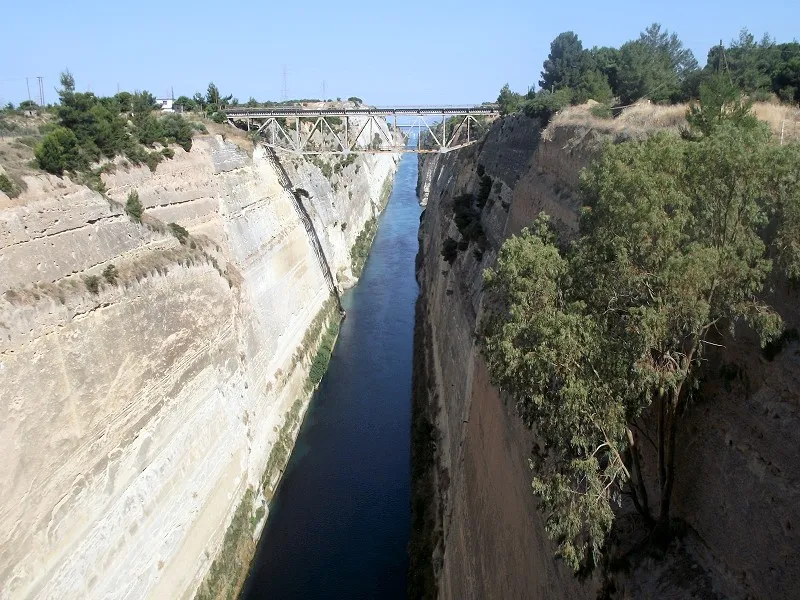
You stop on the bridge and look down into a slot 79 metres deep and 25 metres wide, cut through solid limestone between 1882 and 1893. Ships still pass through it, and they still pass under tow, because there is no room to steer.
The idea is far older than the cut. Periander of Corinth wanted a canal here in the 7th century BC and decided against it — too expensive, and possibly too dangerous to Corinth’s own monopoly. What he built instead was the Diolkos: a paved stone trackway across the six kilometres of the isthmus, with grooves cut into it, along which ships were hauled on wheeled cradles from one sea to the other. It worked for something like seven hundred years. Sections of it survive beside the modern canal.
Nero tried the canal in 67 AD with six thousand Jewish prisoners of war and broke the first ground himself with a pickaxe. He got about a tenth of the way across before he died and the work stopped. The modern canal follows his line.
Ancient Corinth: the Roman city
Corinth was rich because of where it sits. Anything moving between the Aegean and the Adriatic either went around the Peloponnese — a long, dangerous sail past Cape Malea — or came through here and paid. By the 8th century BC the city was already wealthy on it.
Rome destroyed Corinth utterly in 146 BC, killed or enslaved the population, and left the site empty for a century. Then Julius Caesar refounded it in 44 BC as a Roman colony, and it became the capital of the province of Achaia and one of the great cities of the empire again — Roman in law, Greek in bone, and cosmopolitan in a way that made moralists nervous. What you walk through is that Roman city.
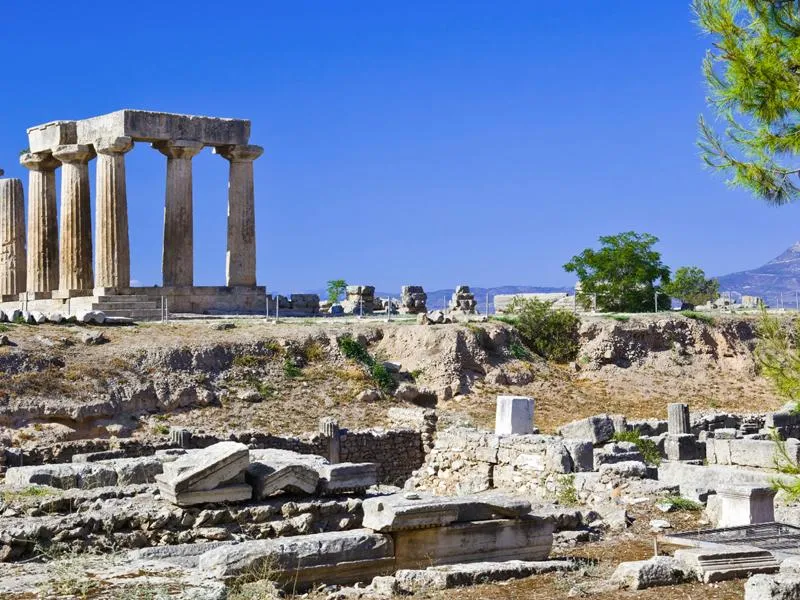
Above it stands the Temple of Apollo, and it is older than everything around it: 6th century BC, one of the earliest stone temples in Greece, with seven of its original thirty-eight Doric columns still standing — each cut from a single block of stone rather than assembled from drums. It survived the Roman destruction, and it was still functioning when Paul walked past it.
Below it opens the forum, the largest in Greece, and the Lechaion Road — the marble-paved avenue that ran down to the port, lined with shops and statue bases, still there under your feet. The Peirene Fountain is the city’s water source and its most beautiful ruin: a rock-cut basin system with chambers and a courtyard, named for a woman who wept so hard at her son’s death that she dissolved into the spring. It is also where Bellerophon is said to have caught Pegasus drinking.
The Bema: where St Paul stood
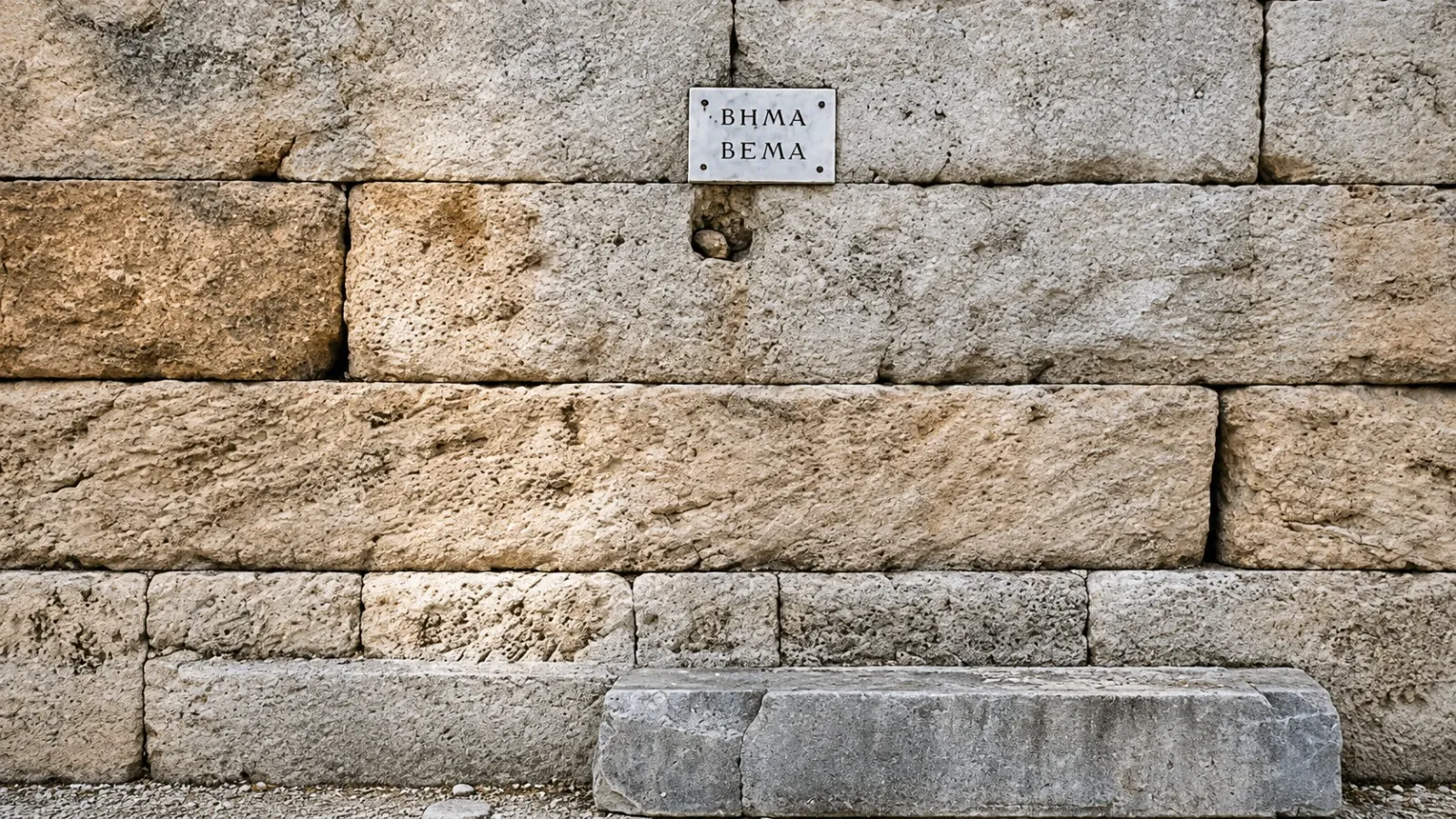
On the south side of the forum is a marble-faced platform rising a couple of metres above the pavement. It is the bema — the judgment seat, where Roman magistrates heard cases in public, in the open, in front of whoever was in the market that day.
Paul lived in Corinth for eighteen months, from about 50 to 52 AD, working as a tentmaker alongside Aquila and Priscilla. In roughly 51 he was dragged here and accused before Lucius Junius Gallio, the proconsul of Achaia — brother of the philosopher Seneca. Gallio heard the charge, decided it was a religious dispute rather than a matter of Roman law, refused to rule, and had the whole party cleared out of court (Acts 18:12–17). Paul stayed. The letters he later wrote back to this city are 1 and 2 Corinthians.
This is one of the very few places in the New Testament you can stand on. Not a plausible location, not a traditional site — the actual platform, identified by a Latin inscription found beside it.
And the date is anchored. In the early twentieth century, French archaeologists at Delphi — 130 km north — dug up nine fragments of a letter from the emperor Claudius that names “Lucius Junius Gallio, my friend, and proconsul of Achaia.” Claudius’s own titles in the text date it to 52 AD, which fixes Gallio’s one-year term to 51–52, which fixes Paul. The Gallio Inscription is the single most secure chronological anchor in the entire New Testament, and everything else in Paul’s timeline is dated by working outward from it.
It is on display in the Delphi Archaeological Museum — which you can see on our full-day Delphi tour. The seat and the document that dates it are 130 km apart, and between the two tours you can see both.
The Archaeological Museum
Small, and unusually rich in things that connect to texts. It holds the Erastus inscription — a paving block recording that an aedile named Erastus laid it at his own expense, and very plausibly the same Erastus Paul greets in Romans 16:23. There is a synagogue inscription, menorah reliefs, and the mosaics and sculpture of the Roman colony.
And there are the votives to Asklepios: hundreds of terracotta body parts — hands, feet, limbs, breasts, genitals — left by people asking to be healed of that specific thing, or thanking the god that they had been. They are displayed together, and the effect is not what you expect from an archaeological museum.
Acrocorinth
Επαληθεύτηκε. Ορίστε η ενότητα:
H3 — Acrocorinth
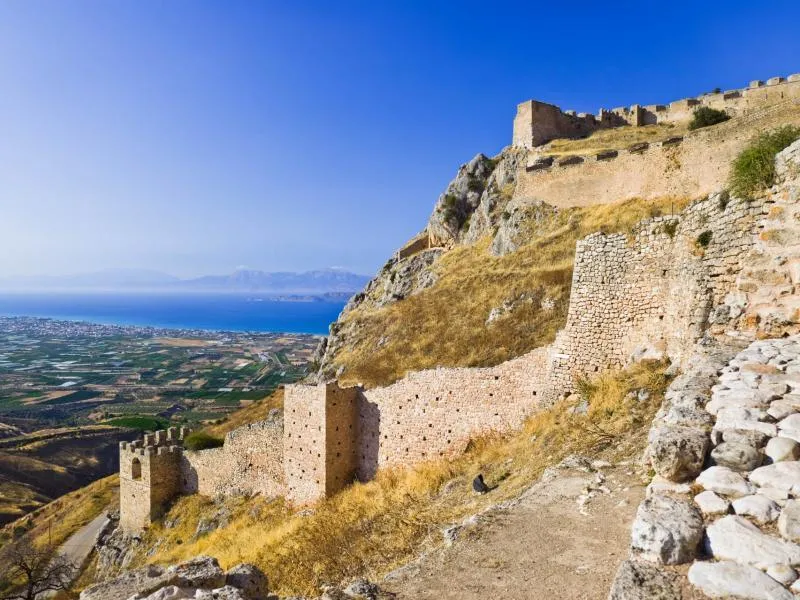
The mountain above the site is not scenery. It is the fortress, and it is the reason the city is where it is.
Acrocorinth stands on a monolithic rock at 575 metres, and it is the largest castle in the Peloponnese — three kilometres of wall enclosing 240,000 square metres, three successive lines of defence, three gates. It was fortified in the late 7th century BC by the Cypselid tyrants — the same dynasty, and the same Periander, who built the Diolkos. It was then occupied without a break until the early 19th century. Almost nothing in Greece has been in continuous use for that long.
Everyone who wanted Greece wanted this rock. Under the Macedonians it was one of the “Fetters of Greece” — three fortresses, with Demetrias and Chalcis, that were understood to hold the whole country between them. Mummius destroyed it in 146 BC and Julius Caesar rebuilt it. Justinian repaired it in the 6th century. It became the Byzantine command post for southern Greece, and then it went, in turn, to Franks, Knights Hospitaller, Byzantines again, Venetians and Ottomans — each of whom pulled down some of what the last one built and used the stone.
The story people remember is Leon Sgouros. Holding out against the Frankish siege in 1208, out of supplies and out of allies, he blindfolded his horse, opened a gate above the cliff and spurred it forward. The castle itself held for another two years. The small Frankish fort the besiegers built to watch him — Penteskoufi — is still standing on the peak opposite.
Inside the walls is the whole of Greek history stacked in one place: a Frankish tower, Byzantine cisterns, Ottoman mosques and fountains, a Venetian chapel. On the summit stood the Temple of Aphrodite, small — about ten metres by sixteen — from the 5th or 4th century BC. It was made into an early Christian basilica, and then into a mosque. One building, three religions, on the highest rock in the Corinthia.
And behind it, the Upper Peirene spring. Steps cut into rock drop into a vaulted chamber, and there is water in it — there has always been water in it. This is what made the fortress unconquerable by siege, and the ancients explained it the way they explained anything inexplicable: Sisyphus knew that Zeus had carried off Asopus’s daughter, and traded the information for a spring that would never fail.
The view from the top runs to both gulfs, the plain of Argos, Parnassos and Kithairon.
Is the price per person or per group?
Per group. The €370 covers the whole tour for up to 7 passengers travelling together in one minivan — it is not multiplied by the number of people. A group of two and a group of seven pay the same total.
How long is the tour and where does it start?
About 6 hours, starting and ending in Athens with pick-up and drop-off at your hotel. Corinth lies roughly 80 km west of the city.
Is a guide included in the price?
No. The price includes an English-speaking driver, not a licensed guide. A licensed guide can be added for €280; for languages other than English, contact us. When you book a guide, remote guiding devices (“whisperers”) are included at no extra cost.
What does the tour include?
The Corinth Canal, the archaeological site of Ancient Corinth and its Archaeological Museum, and the fortress of Acrocorinth on the hill above.
Are entrance fees included?
No. Entrance fees to the archaeological site and museum are paid on the spot.
How many people can join this tour?
Up to 7 passengers in one private minivan. For larger parties, contact us for a tailor-made arrangement.
Is this tour suitable for children?
Yes. The private format lets you set the pace, and the site involves gentle walking. Acrocorinth has steeper, uneven ground, so comfortable shoes help.
Can the tour be combined with other sites?
Yes — it works well extended toward Nemea or the Argolid (Mycenae, Nafplio, Epidaurus). For a fully bespoke route, see our tailor-made tours.
When is the best time to go?
Spring and autumn are the most comfortable, especially for the climb at Acrocorinth. Summer is hot and best done earlier in the day; the site has little shade.
Included in the tour price:
- English speaking driver
- Pick-up & Drop-off service from the hotel
- Remote guiding system (“whisperers” devices) when you book guide services
- All expenses of the driver (accommodation during multi-day tours, meals, insurance)
- Tolls
- All currently applicable taxes
Not included in the tour price:
- Accommodation during multi-day tours & meals for the guests; we can assist you with these arrangements
- Entrance fees to museums & archaeological sites: these are payable on the spot, as you go
- Guide Services unless you select the extra service