
Full Day To Argolis
460€ / Per group up to 7 persons
Private 10-hour tour from Athens to Mycenae, Epidaurus and Nafplio — two UNESCO sites. Hotel pick-up. €460 per group of up to 7.
10 hours
Private tour
Up to 7 passengers
Hotel pickup & drop-off
English-speaking driver
Overview
About This Private Tour
A ten-hour private tour into the Argolid, the corner of the Peloponnese where Greek history starts: Mycenae, the theatre of Epidaurus and the harbour town of Nafplio, with the Corinth Canal on the way in. Mycenae and Epidaurus are both UNESCO World Heritage Sites — inscribed in 1999 and 1988. We collect you from your hotel in Athens in the morning and bring you back to the door. The price is €460 for the whole group of up to 7 people, not per person. Entrance fees are not included; a licensed guide can be added for €280.
Then back to Athens.
An hour and a bit out of Athens the road reaches the Corinth Canal, and you stop on the bridge to look down: a slot cut 79 metres through solid limestone between 1882 and 1893, narrow enough that ships still pass under tow. On the far side, the Peloponnese.
The country beyond opens into the Nemea valley — vineyards now, and the mythological address of the lion that Heracles was sent to kill as the first of his twelve labours. Its hide, which no weapon could pierce, he wore afterwards. The valley’s modern fame is Agiorgitiko, the red grape grown here since antiquity and named, like most things in Greece, for a saint rather than a hero.
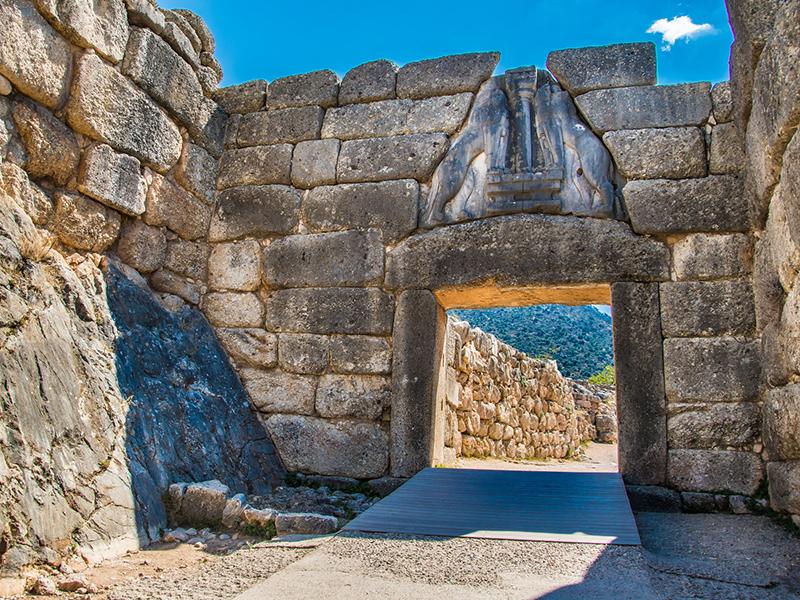
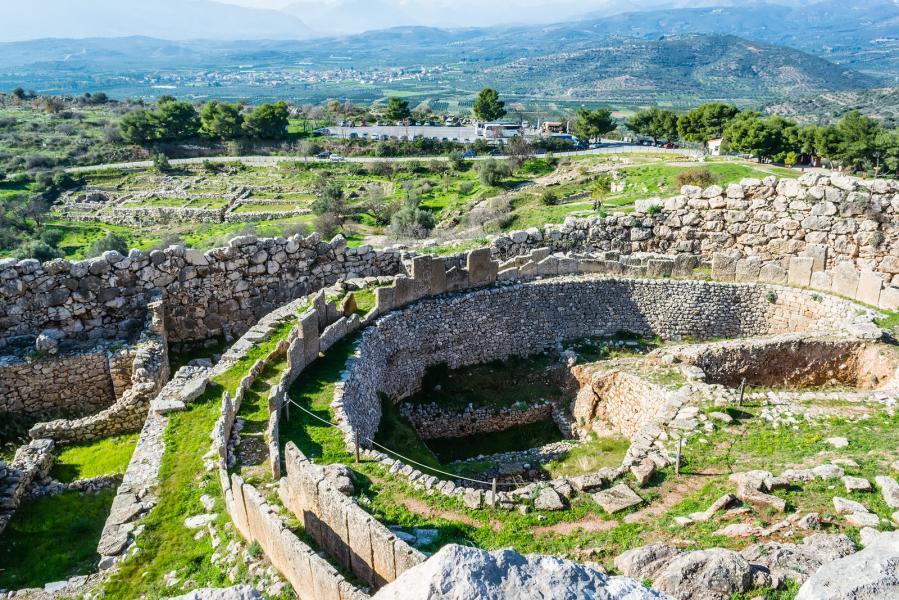
Mycenae is the reason to come. You enter as everyone has entered for three thousand years, through the Lion Gate, into a citadel of stone blocks so large that later Greeks assumed the Cyclopes had stacked them. This was the seat of Agamemnon, who with his brother Menelaus of Sparta is said to have raised the fleet for Troy — and it was a real power in a real world. Hittite archives from the fourteenth and thirteenth centuries BC record a western kingdom called Ahhiyawa, almost certainly the Mycenaean Greeks, discussed in the same correspondence as Egypt and Hatti. The tholos tombs below the citadel are the quiet marvel: beehive vaults of dry-laid stone whose span went unmatched in Europe for the next fifteen hundred years. UNESCO inscribed Mycenae in 1999, together with nearby Tiryns.
Nafplio comes next, and it is where you stop for lunch — a seaside town under the Palamidi fortress, Venetian and Ottoman and neoclassical in the same three streets, and the first capital of the Greek state in 1829. The waterfront is the reason people move here.
The last stop is Epidaurus. The sanctuary of Asklepios was antiquity’s foremost healing centre — patients slept in the abaton and told the priests their dreams — but what survives best, and what you come for, is the theatre. Fourth century BC, still in use every summer, and with acoustics that carry an ordinary speaking voice from the orchestra to all fourteen thousand seats. Someone in your group will test it. Everyone does. UNESCO inscribed it in 1988.
Mycenae: the Treasury of Atreus
Outside the walls, below the citadel, is the thing that most people are unprepared for.
A dromos — a walled passage thirty-six metres long — runs straight into the hillside and stops at a doorway. Above that doorway sits a single lintel stone weighing about 120 tonnes. Nobody has fully explained how it was placed. Then you step through, and the space opens over your head.
The Treasury of Atreus is a beehive vault 14.5 metres across and roughly 13 metres high, built around 1250 BC out of thirty-three rings of dressed stone, each projecting slightly further inward than the one below, closing at a single capstone. No mortar. The joints are tight enough that a knife blade struggles to enter them, after three thousand three hundred years.
It was the largest dome in the world for over a thousand years — nothing surpassed it until the Romans discovered what concrete could do. And it remains, to this day, the largest corbelled dome ever built by anyone. The Pantheon is bigger, but the Pantheon is concrete. This is stacked rock.
It was named for Atreus, father of Agamemnon, by people guessing. It was robbed in antiquity — it was never buried, so it was never hidden — and we have no idea who was buried in it. The acoustics inside are extraordinary and everyone discovers this by accident.
Mycenae, together with nearby Tiryns, was inscribed on the UNESCO World Heritage List in 1999.
The theatre of Epidaurus
The theatre of Epidaurus was built in the fourth century BC and cut directly into the hillside, which is why it has survived while grander things have not — there was nothing to fall down. Fifty-five rows of limestone seating curve around an orchestra of beaten earth, and it holds around fourteen thousand people.
Its reputation rests on the acoustics, and the reputation is earned. A voice speaking normally in the orchestra — not shouting, speaking — reaches the last row. So does a coin dropped on the stone, a match struck, a sheet of paper torn. Someone in your group will go down and test it while everyone else climbs to the top. Everyone does this. It works.
How it works is still argued over. The most persuasive explanation is that the limestone seating acts as a filter, damping the low-frequency background noise of a crowd and an open valley while reflecting the higher frequencies of a human voice — the rows themselves are the instrument. Whether the builders understood this or arrived at it by ear, nobody knows.
It is not a ruin under glass. The theatre is still in use: every summer the Epidaurus Festival stages ancient drama here, in the building the plays were written for, and it seats a modern audience without modification.
Nafplio
Nafplio is where you stop to eat, and it is the only town on this tour that is simply a good place to be.
It was the first capital of the Greek state, from 1829 — the seat of Kapodistrias, the first governor, who was assassinated on the steps of a church here in 1831. The parliament of the new country met in a converted mosque that still stands on the main square. The capital moved to Athens in 1834, and Nafplio has been quietly getting on with itself ever since, which is why it is intact.
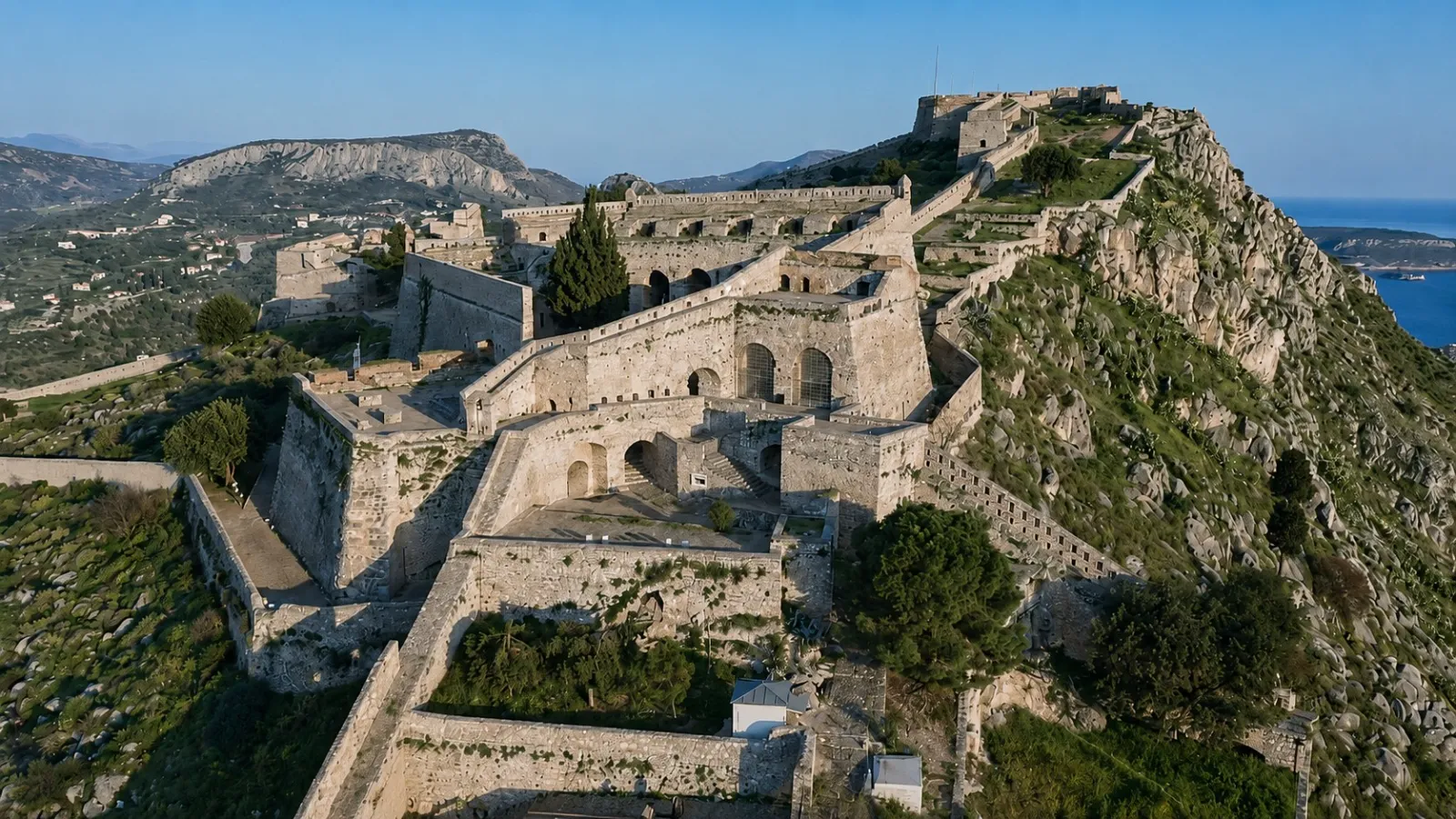
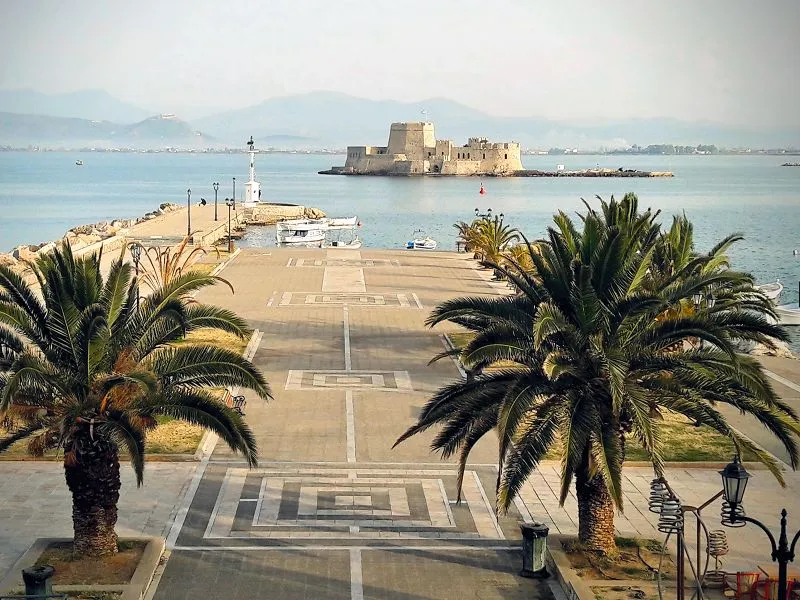
Three fortresses look down on it, all built by people who wanted the harbour. Palamidi, on a hill of 216 metres, is the reason the skyline looks like that: eight self-contained bastions raised by Venetian engineers between 1711 and 1714 — a fortress built in three years, and lost to the Ottomans in 1715, the year after it was finished. There is a stair of 857 steps up to it, which local legend rounds to 999, and there is also a road. Akronafplia, the older fortress, sits on the ridge behind the town. Bourtzi is the small one on the islet in the middle of the harbour, built by the Venetians in 1471, later the residence of the state executioner — who lived out there because the townspeople would not have him among them.
The old town below is Venetian and Ottoman and neoclassical within the same three streets: marble paving, balconies on iron brackets, a square of cafés, and a waterfront promenade that runs around the rock to a swimming beach. The Archaeological Museum occupies the Venetian barracks on Syntagma Square and holds, among other things, a complete bronze suit of Mycenaean armour from Dendra — an entire panoply, from a warrior who wore it in the fifteenth century BC.
Is the price per person or per group?
Per group. The €460 covers the whole 10-hour tour for up to 7 passengers in one minivan — it is not multiplied by the number of people.
Which UNESCO World Heritage Sites does this tour visit?
Two. The Archaeological Sites of Mycenae and Tiryns, inscribed in 1999, and the Sanctuary of Asklepios at Epidaurus, inscribed in 1988.
Does this tour visit Ancient Corinth?
No. We stop at the Corinth Canal for the view, but not at the archaeological site of Ancient Corinth, which is a separate 6-hour tour from Athens.
Why take this rather than the 2-day Argolis tour?
If you only have one day, this reaches Mycenae, Epidaurus and Nafplio comfortably. The 2-day version adds a night in Nafplio, the Palamidi fortress, the archaeological museum, a Nemea winery and an olive press — and removes the driving from the end of the day.
Is a guide included?
No. The price covers an English-speaking driver, not a licensed guide. A licensed guide can be added for €280; for languages other than English, contact us. When you book a guide, remote guiding devices are included.
Are entrance fees included?
No. Entrance fees to Mycenae and Epidaurus are paid on the spot.
How much driving is there?
Roughly an hour and a half from Athens to Mycenae, then short hops — everything in the Argolid is close together. Nafplio to Epidaurus is about half an hour. The tour runs around ten hours door to door.
How much walking is there?
Mycenae is a hillside citadel with a steady climb on uneven ground, and the tholos tombs are a short walk from the main gate. Epidaurus is mostly flat, but the theatre’s upper rows are a steep climb if you want the acoustics test from the top.
When is the best time of year?
Spring and autumn. Mycenae has almost no shade and is punishing in July and August. Summer does bring the Epidaurus drama festival, when the theatre is used as it was built to be used.
Included in the tour price:
- English speaking driver
- Pick-up & Drop-off service from the hotel
- Remote guiding system (“whisperers” devices) when you book guide services
- All expenses of the driver (accommodation during multi-day tours, meals, insurance)
- Tolls
- All currently applicable taxes
Not included in the tour price:
- Accommodation during multi-day tours & meals for the guests; we can assist you with these arrangements
- Entrance fees to museums & archaeological sites: these are payable on the spot, as you go
- Guide Services unless you select the extra service