
Full Day To Delphi
460€ / Per group up to 7 persons
Private 10-hour tour from Athens to Delphi and the Hosios Loukas monastery — two UNESCO World Heritage Sites. €460 per group of up to 7.
10 hours
Private tour
Up to 7 passengers
Hotel pickup & drop-off
English-speaking driver
Overview
About This Private Tour
Delphi’s other argument is the view. The sanctuary looks out over the olive grove of Amfissa, which runs unbroken down to the sea at Itea — and on the way back the road passes through Arachova, a stone village on the Parnassos slope, better known in winter than in summer.
A ten-hour private tour to Delphi, the place the ancient Greeks held to be the centre of the world, with a stop on the way at the Byzantine monastery of Hosios Loukas. Both are UNESCO World Heritage Sites — Delphi inscribed in 1987, Hosios Loukas in 1990. We collect you from your hotel in Athens early in the morning and bring you back to the door.
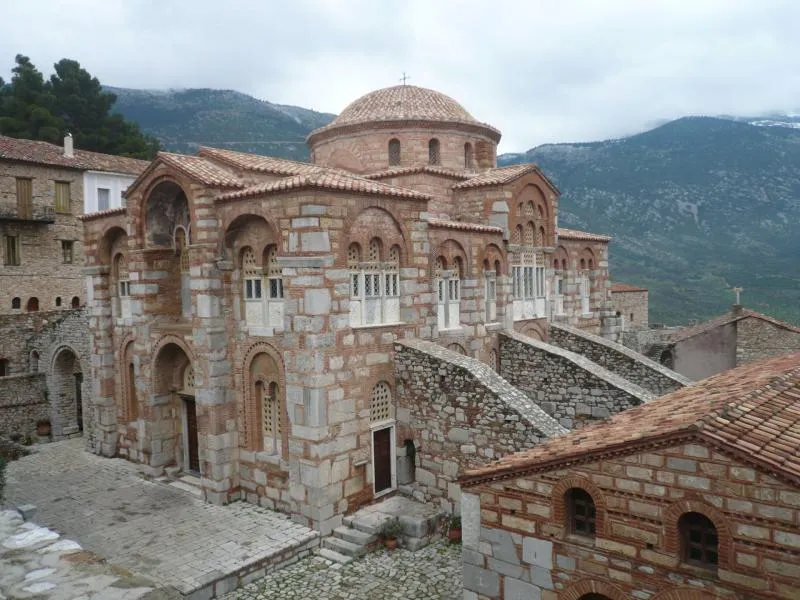
The road runs north-west out of Attica into Boeotia, and after about two hours reaches the ground where Helicon and Parnassos face each other across the plain. Hosios Loukas is built into the western slope of Helicon, behind its own walls. A hermit called Loukas of Steiris settled here in the early tenth century; he died in 953 and lies in the crypt, beneath a church he did not live to see finished. Inside the Katholikon are gold-ground mosaics untouched since the eleventh century — the best-preserved programme of their kind left in Greece. Most day trips to Delphi drive past the turning.
From there the road climbs. Delphi sits on the southern flank of Parnassos, on a shelf of rock above a ravine, and you see it long before you arrive. Zeus, the story goes, released two eagles from opposite ends of the earth; where they met he marked the centre of the world, and a stone — the Omphalos, the navel — was set here on the spot.
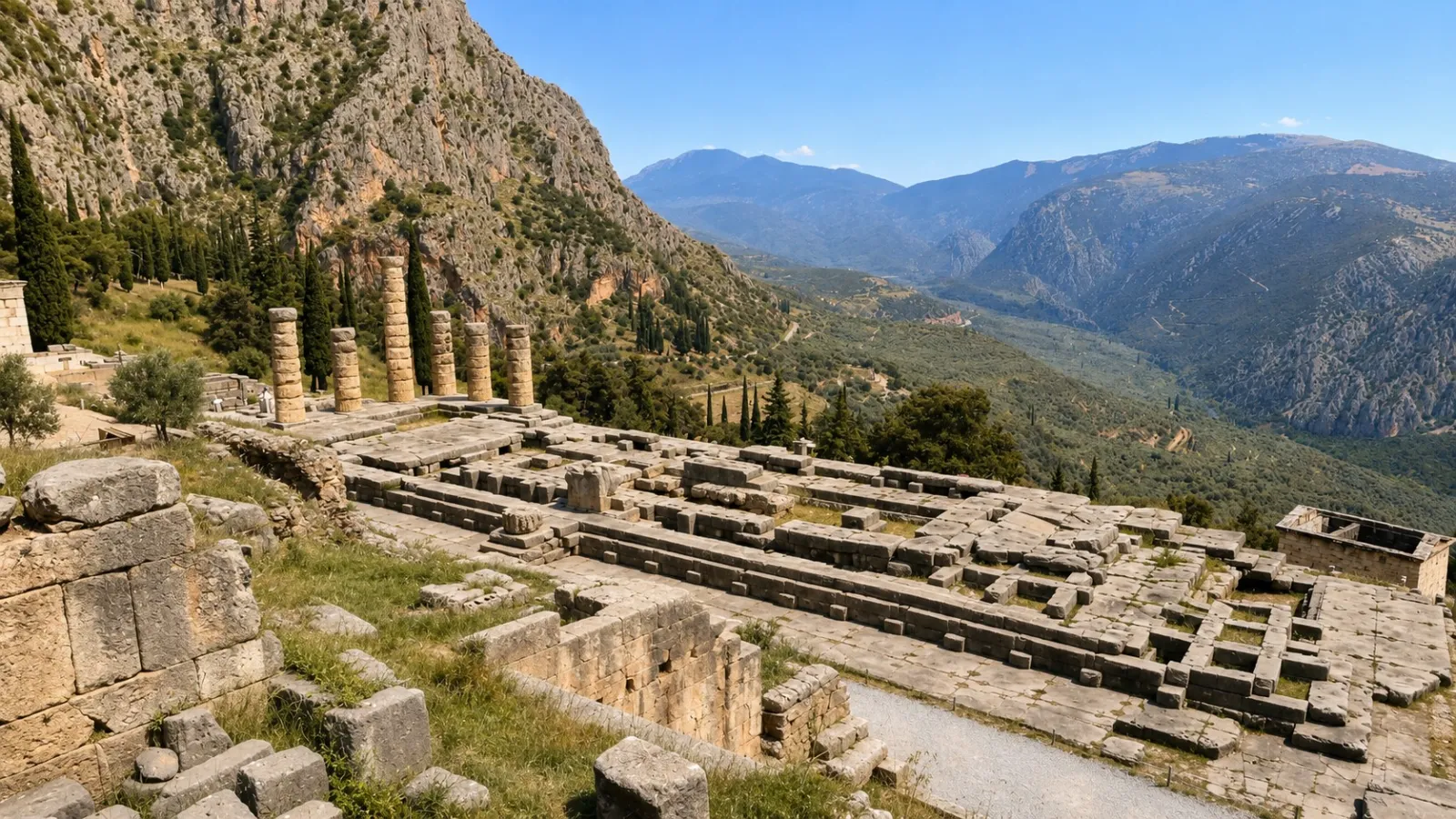
The sanctuary grew around the Temple of Apollo, and inside it the Pythia gave the god’s answers in verse for the priests to interpret. For roughly a thousand years no Greek state made a serious decision without asking here first. The Sacred Way climbing to the temple is lined with the treasuries the city-states built to hold their offerings — piety and public accountancy in the same marble. The oracle’s last recorded answer came in about 393 AD, when Theodosius I ordered the pagan sanctuaries closed. It had been in business for a millennium.
The Omphalos is in the archaeological museum now, along with the Charioteer of Delphi — cast in bronze around 470 BC, buried by a landslide, and dug out in 1896 with his enamel eyes still in place. Almost every large Greek bronze was eventually melted down for the metal. This one survived by being lost.
Hosios Loukas monastery (UNESCO, 1990)
A walled monastery on the western slope of Mount Helicon, founded in the early 10th century by the hermit Loukas of Steiris — who died in 953 and is still buried in the crypt below the church he never lived to see finished.
What makes it matter: the Katholikon holds the best-preserved mosaic programme of the Macedonian Renaissance surviving in Greece — gold-ground mosaics, marble revetment, and a crypt whose frescoes were only cleaned in the 1960s after centuries under dust. UNESCO inscribed it in 1990 together with Daphni near Athens and Nea Moni on Chios; Hosios Loukas is the largest of the three, and the only one dedicated to a single saint.
Most day trips to Delphi drive straight past it.
Delphi: the sanctuary (UNESCO, 1987)
Zeus is said to have released two eagles from opposite ends of the earth; where they met he marked the centre of the world, and the Omphalos — the navel stone — was set at Delphi to mark the spot.
For roughly a thousand years, no Greek state made a serious decision without asking here first. Kings, generals and colonists climbed the Sacred Way past the treasuries — small marble buildings that each city-state raised to hold its offerings, and which functioned as a public display of wealth as much as piety — up to the Temple of Apollo, where the Pythia delivered the god’s answers in verse that the priests interpreted.
The oracle’s influence ran through most of the major events of Greek history. Its last recorded prophecy came in about 393 AD, when the emperor Theodosius I ordered the closure of the pagan sanctuaries. It had been answering questions for a millennium.
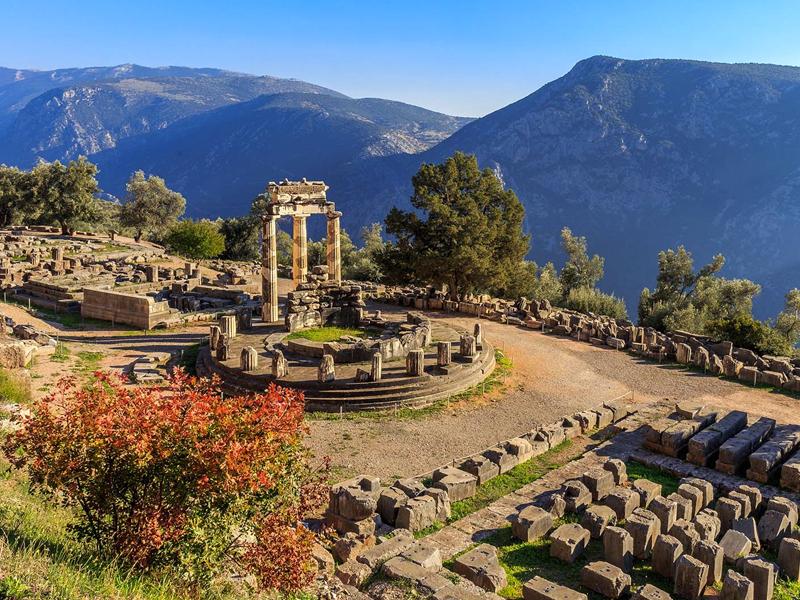
Below the main site sits the Tholos at the sanctuary of Athena Pronaia — a circular building of the early 4th century BC whose purpose is still unknown, and the single most photographed thing at Delphi.
The setting is half the reason to come: the sanctuary looks out over the olive grove of Amfissa, which runs unbroken down to the sea at Itea.
Delphi: the archaeological museum
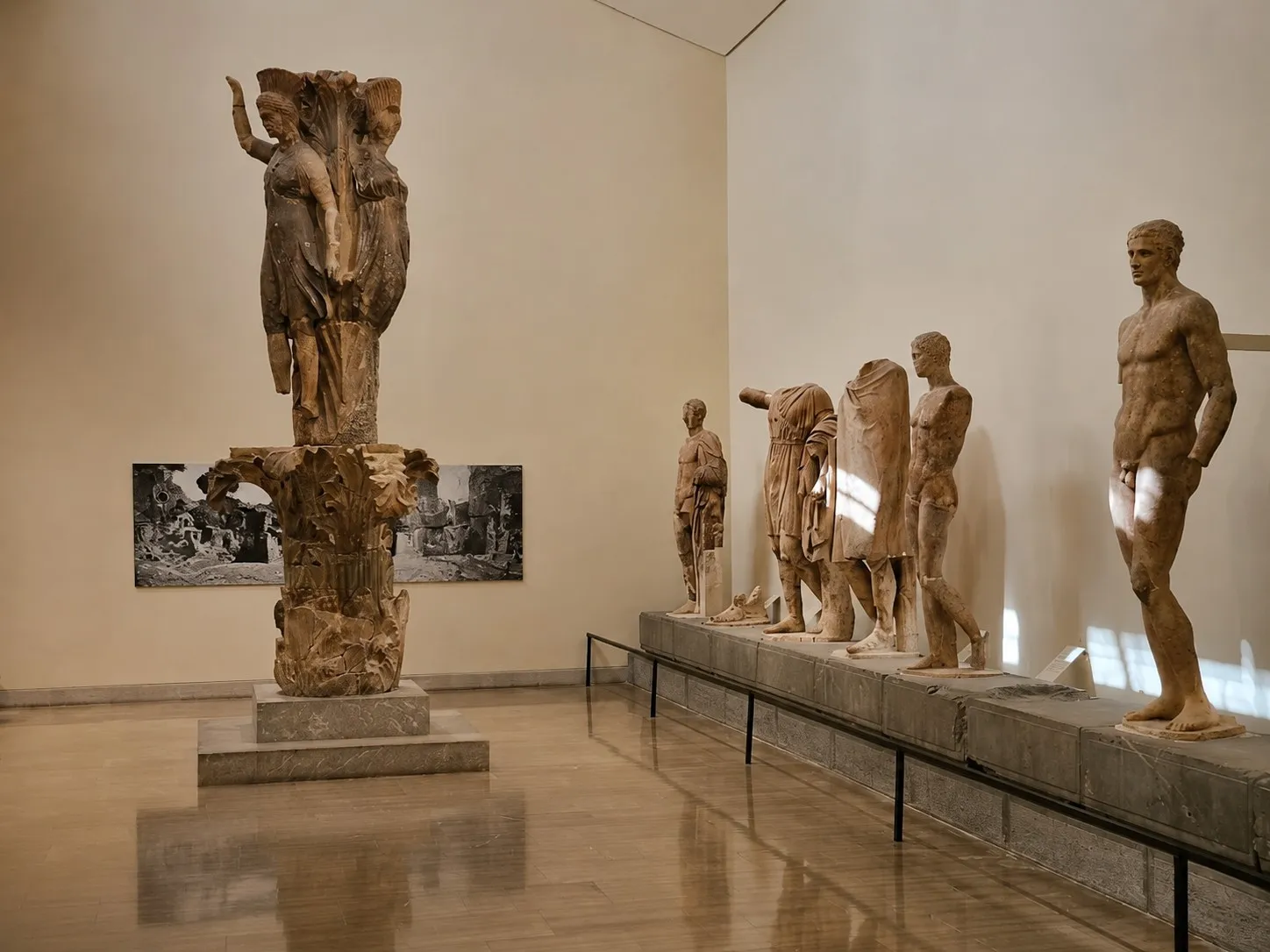
The museum holds the Charioteer of Delphi (Iniochos): cast in bronze in about 470 BC, buried by a landslide, and recovered in 1896 essentially intact — with his enamel-and-stone eyes still in place. Very few large Greek bronzes survive at all; almost all were melted down. This one survived by being lost.
The Omphalos is here too, along with the friezes of the Siphnian Treasury and the twin archaic kouroi.
Is the price per person or per group?
Per group. The €460 covers the whole 10-hour tour for up to 7 passengers in one minivan — it is not multiplied by the number of people.
Which UNESCO World Heritage Sites does this tour visit?
Two. Delphi, inscribed in 1987, and the monastery of Hosios Loukas, inscribed in 1990 as part of the Monasteries of Daphni, Hosios Loukas and Nea Moni of Chios.
How long is the drive to Delphi from Athens?
Roughly two and a half hours each way, with the Hosios Loukas stop on the outbound leg. The tour runs about ten hours door to door.
Is Hosios Loukas included, or is it extra?
Included. It is a scheduled stop on the way to Delphi, at no extra cost. Its entrance fee, like Delphi’s, is paid on the spot.
Is a guide included?
No. The price covers an English-speaking driver, not a licensed guide. A licensed guide can be added for €280 and covers the day; for languages other than English, contact us. When you book a guide, remote guiding devices are included.
Are entrance fees included?
No. Entrance fees to Delphi’s archaeological site and museum, and to Hosios Loukas, are paid on the spot.
Can we do Delphi as a day trip, or do we need to stay overnight?
A day trip works. Ten hours is enough for Hosios Loukas, the sanctuary, the museum and lunch without rushing — because the tour is private, you set the pace at each stop. If you want Delphi as part of a longer route, it is Day 5 of our 5-day Peloponnese & Delphi tour.
When is the best time of year?
Spring and autumn are the most comfortable. Delphi sits high on Parnassos, so summer is cooler here than in Athens but the site is exposed and there is little shade. Winter is possible; snow can occasionally affect the mountain road.
How much walking is there?
The Delphi sanctuary is built on a steep hillside and the Sacred Way climbs continuously — expect a sustained uphill walk on uneven ancient paving. Hosios Loukas is largely flat. Comfortable shoes matter more here than at most sites.
Included in the tour price:
- English speaking driver
- Pick-up & Drop-off service from the hotel
- Remote guiding system (“whisperers” devices) when you book guide services
- All expenses of the driver (accommodation during multi-day tours, meals, insurance)
- Tolls
- All currently applicable taxes
Not included in the tour price:
- Accommodation during multi-day tours & meals for the guests; we can assist you with these arrangements
- Entrance fees to museums & archaeological sites: these are payable on the spot, as you go
- Guide Services unless you select the extra service