Marathon
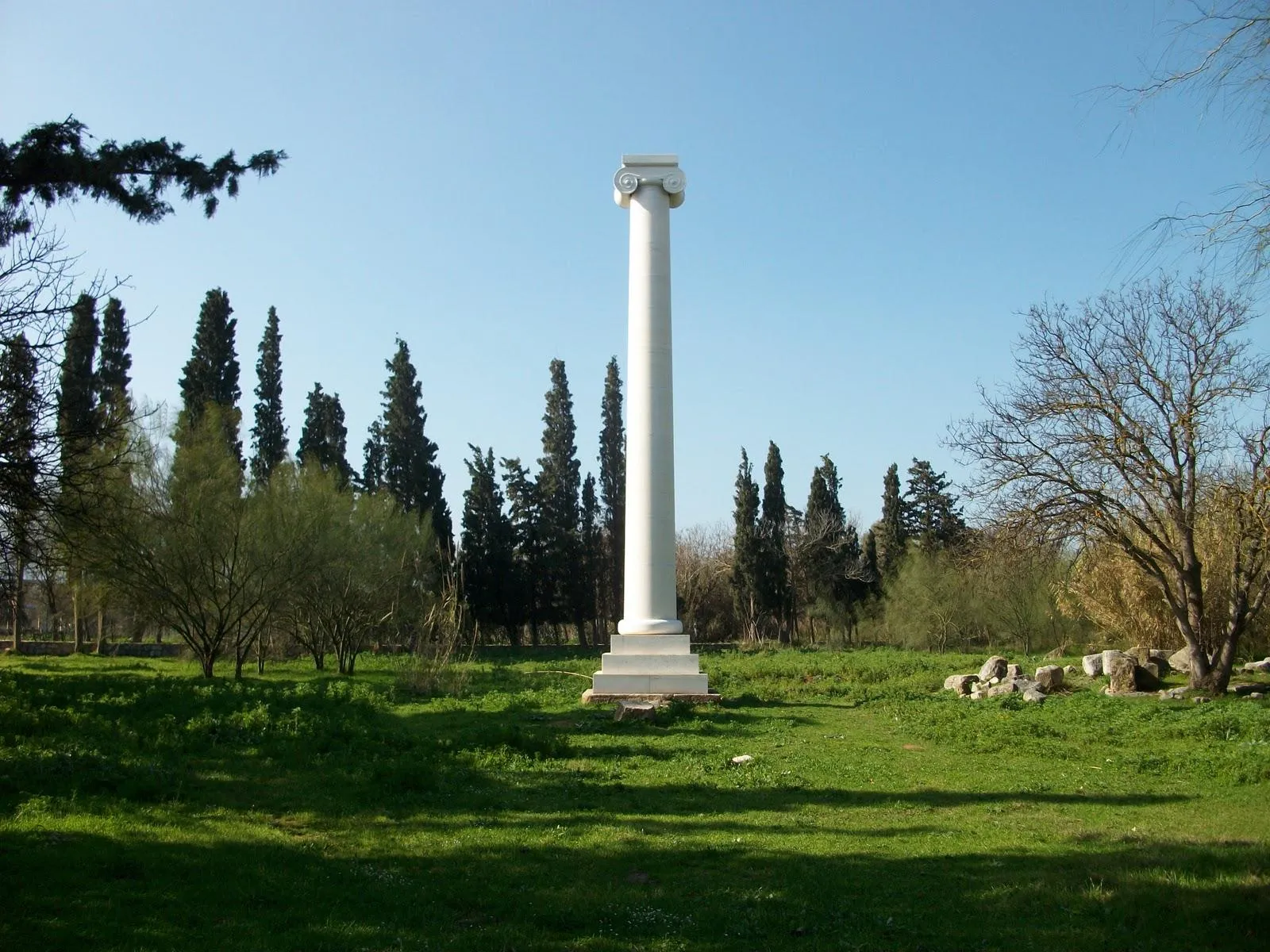
Marathon is a coastal plain about 40 kilometres north-east of Athens, and one of the few places in Greece where the landscape itself is the monument. There is no temple here and no acropolis. There is a flat field between the mountains and the sea, and a mound of earth in the middle of it, under which lie the Athenians who died holding the line in 490 BC.
Marathon is visited on our full-day private tour from Athens.
It is also served by private transfers from Athens, the airport and Piraeus.
See transfer routes to Marathon →
The battle
In 490 BC a Persian force landed on the bay at Marathon, sent by Darius I to punish Athens for supporting a revolt in Ionia. The Athenians marched out to meet them with a contingent from Plataea and no other allies — Sparta had agreed to help but was observing a religious festival and arrived after it was over.
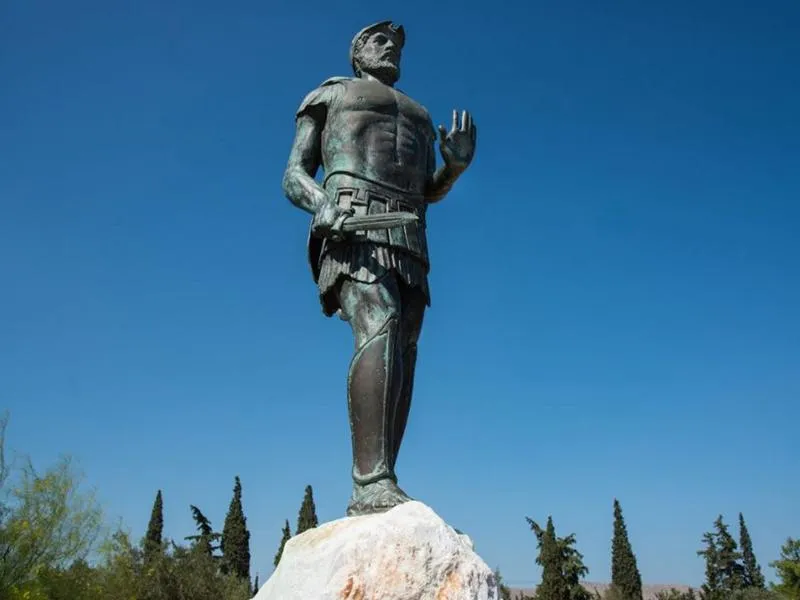
The Athenians were heavily outnumbered. Under Miltiades they thinned their centre and weighted both wings, let the Persian centre push forward, then closed on it from both sides. Herodotus records 192 Athenian dead against 6,400 Persians.
The consequence was out of all proportion to the numbers. It was the first time a Greek army had defeated the Persians in open battle, and it bought Athens the decade that produced the fleet, Salamis and everything that followed.
The Soros
The dead of Marathon were not carried home. They were burned and buried where they fell, under a mound raised on the battlefield — an honour Athens gave to no other war dead.
The Soros still stands on the plain, about nine metres high, and it is the reason to come. It is a plain grassed tumulus in an open field, unmarked and undramatic, and standing at the foot of it is a stranger experience than most archaeological sites can manage. The Plataeans were buried separately, at Vrana a few kilometres inland, near the Archaeological Museum of Marathon.
The run that gave the race its name
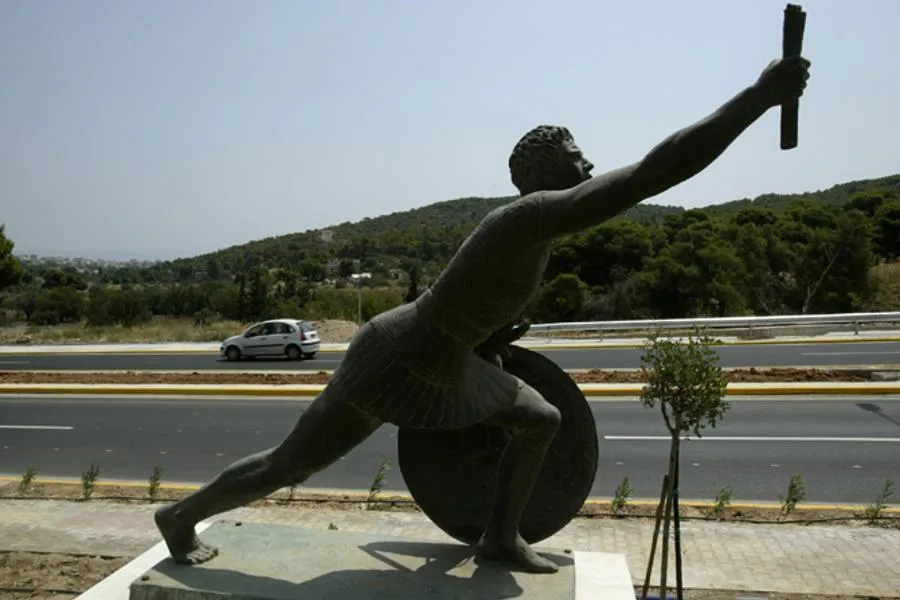
The story that a runner carried news of the victory to Athens, said “we have won”, and died on the spot is a good story, but it is not in Herodotus. It appears centuries later, in Plutarch and Lucian, and the runner is given different names in each.
What Herodotus does record is a different and harder run. Pheidippides, a professional day-runner, was sent from Athens to Sparta before the battle to ask for help — roughly 250 kilometres across the Peloponnese, which he covered in about two days. That run is now retraced each September as the Spartathlon.
The modern race takes its name from the legend rather than the history. The first was run at the 1896 Athens Olympics, from Marathon to the Panathenaic Stadium, and won by Spyridon Louis, a Greek water carrier. The distance was not fixed at 42.195 kilometres until the 1908 London Games. The original route is still run every November as the Athens Marathon.
Around the plain
The Archaeological Museum of Marathon, at Vrana, holds the finds from the battlefield and the surrounding cemeteries, alongside material from the Neolithic cave at Nea Makri.
Lake Marathon lies inland, held by a dam faced in Pentelic marble — the same quarry as the Parthenon — built in the 1920s to supply Athens with water.
Schinias, on the bay, is a long pine-backed beach and a national park, on the shore where the Persian fleet anchored.
Visiting Marathon
| Driving time from Athens Airport | 45 to 65 minutes |
| Driving time from Athens city | 55 to 80 minutes |
| Driving time from Piraeus | 1 hour 10 minutes to 1 hour 35 minutes |
| How long you need | 2–3 hours for the Soros, the museum and the Plataean tomb |
| Best time to visit | Spring and autumn. The plain is open and there is no shade at the Soros |
| Worth knowing | The battlefield sites are spread across several kilometres and are not walkable one to the next |