
Full Day Athens City Tour (6 Hours)
320€ / Per group up to 7 persons
Private 6-hour tour of Athens by minivan: the Acropolis, the Acropolis Museum, Plaka, the Panathenaic Stadium and Syntagma. €320 per group of up to 7.
6 hours
Private tour
Up to 7 passengers
Hotel pickup & drop-off
English-speaking driver
Overview
About This Private Tour
Starting from the hotel, this 6-hour tour ventures across the city’s most well-known landmarks, covering more or less the same itinerary as the 8-hour Athens City Sightseeing Tour. It is shorter in duration as it does not include a visit to the National Archaeological Museum.
After pickup from the hotel, the tour follows a path along Athens’ must-see antiquities, like the Acropolis and the New Acropolis Museum, the Odeon of Herodes Atticus, and the Temple of Olympian Zeus.
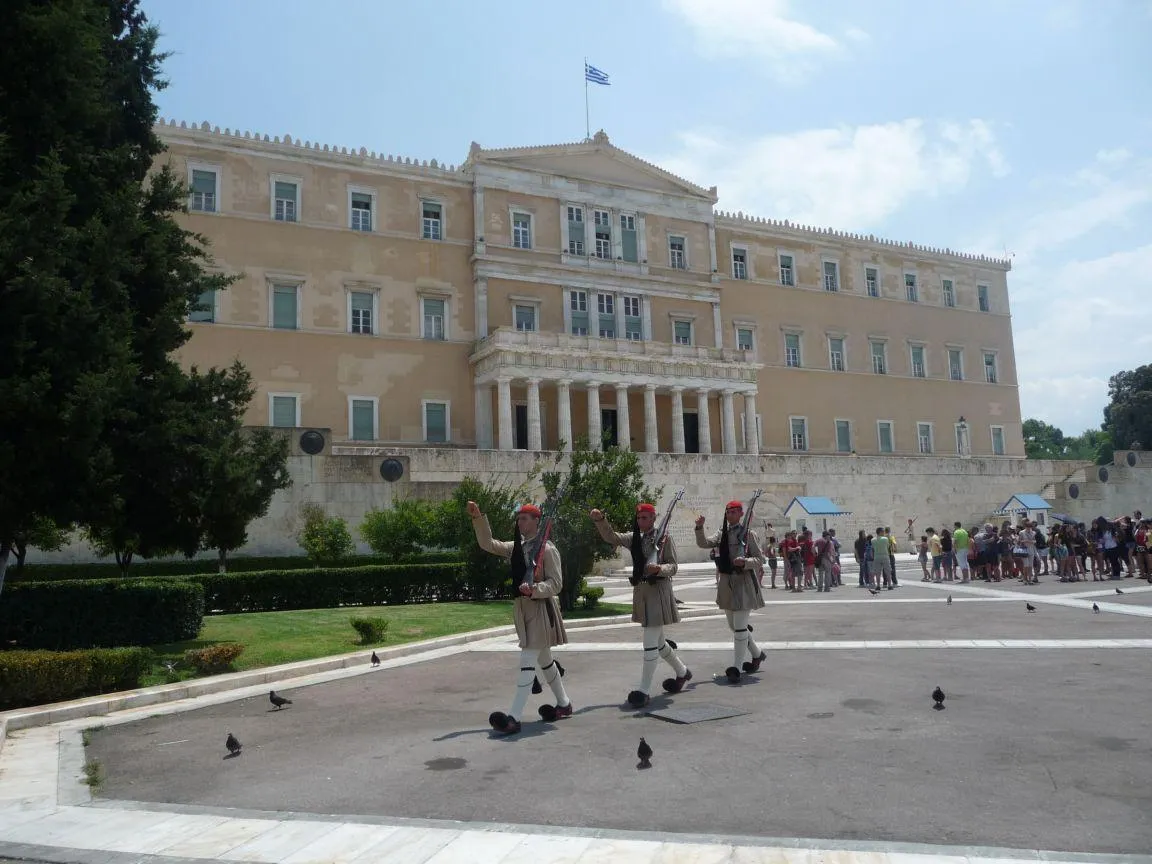
The route also covers the most important markers of Greece’s modern history, including the Parliament and the Tomb of the Unknown Soldier with the Presidential Guard (Evzones) in the Syntagma (Constitution) Square, as well as the Panathenaic Stadium. Also known as the Kallimarmaro (beautiful marble), the stadium was originally built in the 4th century BC, it was restored for the first Olympic Games of modern times in 1896, and is still in use for athletic and cultural events to this day.
A collection of 19th-century buildings, including the National & Kapodestrian University of Athens, the Academy of Athens, the National Library of Greece, and the Zappeion cultural center in the National Garden of Athens, illustrates how the city looked in the early days of its modern era.
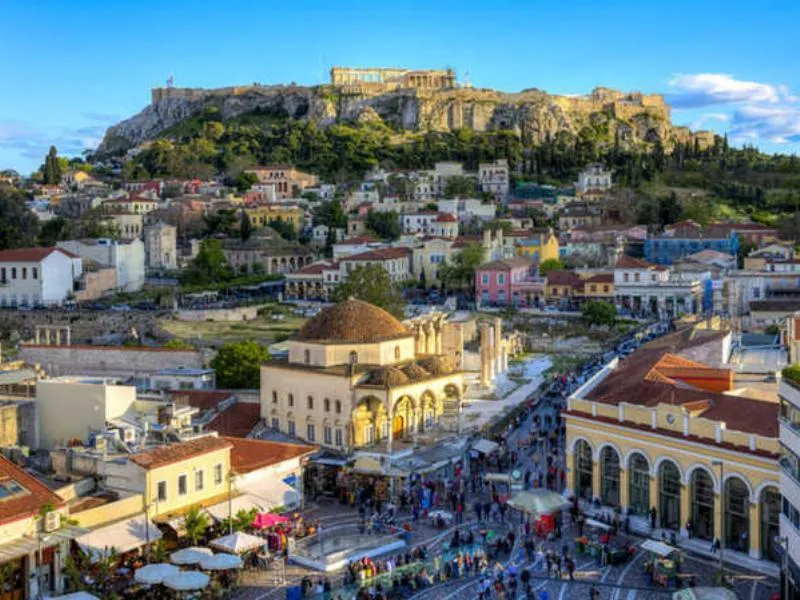
The Athens City Sightseeing Tour will also takes us for a walk through the idyllic Plaka district at the foot of the Acropolis, with its cobbled pedestrian streets bustling with lovely traditional houses, shops, restaurants, cafeterias, bars, theatres and museums.
The Acropolis
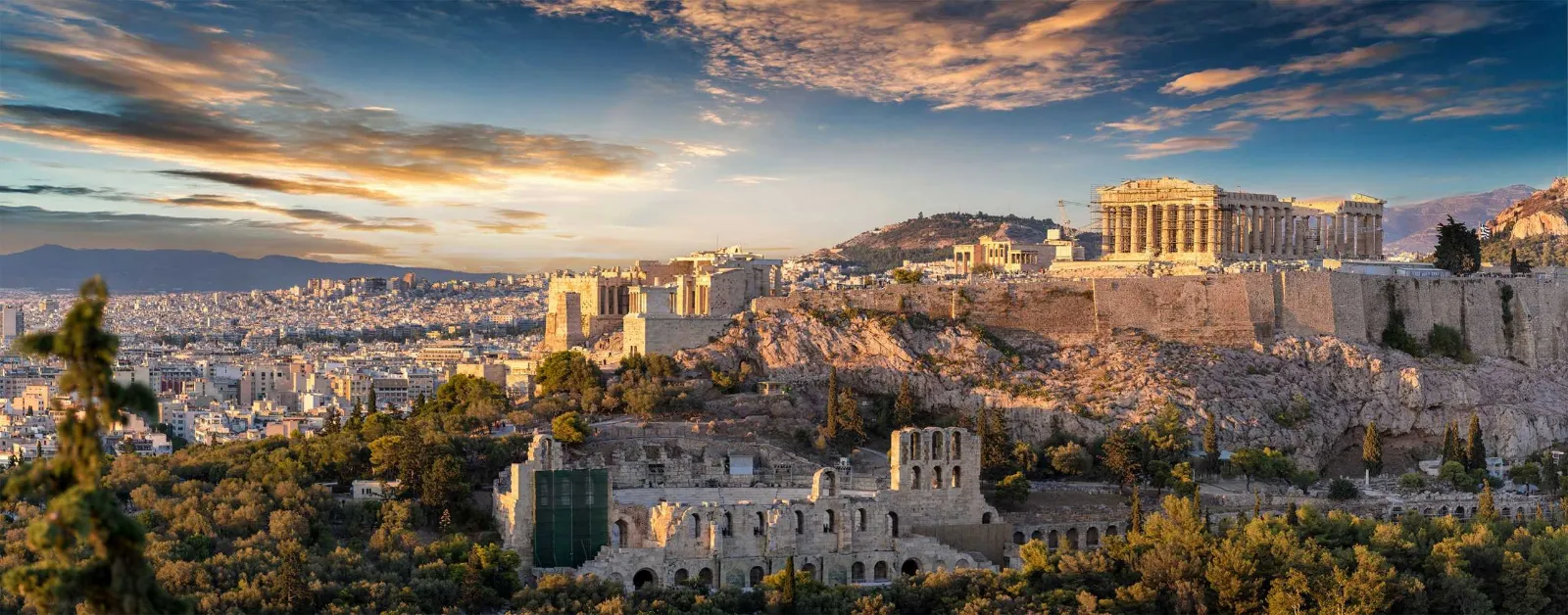
The rock has been occupied since the Neolithic, but what stands on it was built in one extraordinary burst in the fifth century BC, after the Persians burned everything that was there before.
The Parthenon is the reason people come — a temple to Athena built in fifteen years, with almost no straight lines in it: the columns lean inward, the floor bulges upward, the corner columns are thicker. Every correction is invisible and all of them together are why it looks the way it does.
Around it: the Erechtheion, with the six Caryatids holding up the porch — the ones on the rock are copies; five of the originals are in the museum below and the sixth is in London. The Propylaea, the monumental gateway you walk through. And the Temple of Athena Nike on the bastion, small and perfect.
Below the south slope stands the Odeon of Herodes Atticus, built in 161 AD by a wealthy Athenian in memory of his wife. It is still in use — the Athens Festival stages opera and drama in it every summer.
The Acropolis Museum
The building is the argument. It stands at the foot of the rock on concrete pillars, above an excavated Athenian neighbourhood that you walk over on a glass floor before you reach a single exhibit.
The top floor is set at the same angle as the Parthenon and glazed on all four sides, so the frieze is displayed at the height and orientation it was carved for, with the actual building visible through the glass three hundred metres away. Where a panel is missing, there is a white plaster cast in its place. The point is not subtle and it is not meant to be.
The Temple of Olympian Zeus
The largest temple ever built in Greece, and it took almost seven centuries to finish. The Athenians began it in the sixth century BC, gave up, and left it standing half-built for so long that Aristotle used it as an example of political vanity. Hadrian completed it in the second century AD and put a statue of himself next to the statue of Zeus.
Of its original hundred-odd columns, fifteen are standing. A sixteenth lies where it fell in a storm in the nineteenth century, in sections, like a stack of coins knocked over — which is exactly how the columns were built, and you can see it in a way you cannot at any standing temple.
Syntagma, the Parliament and the Evzones
The Parliament was built as a royal palace for Greece’s first king. In front of it is the Tomb of the Unknown Soldier, and in front of that stand the Evzones of the Presidential Guard, in the pleated foustanella and the shoes with pompoms — a uniform that looks decorative and was field dress in the mountains during the War of Independence.
The guard changes every hour, on the hour. They move in a slow, deliberate high step that is not ceremony for its own sake — it is how you march in that footwear without breaking your ankle. The full ceremony, with the band, is on Sunday at 11am.
The Panathenaic Stadium
The Kallimarmaro — “beautiful marble” — is the only stadium in the world built entirely of it.
It began in the fourth century BC as an earth bank for the Panathenaic Games. Herodes Atticus — the same man who built the Odeon under the Acropolis — rebuilt it in marble in the second century AD, and then it was abandoned for sixteen hundred years and quarried for stone.
It was dug out and restored for the first modern Olympic Games in 1896, in the shape it had in antiquity: a long horseshoe with turns so tight that the runners of 1896 lost seconds at every corner. It is still used — the Olympic flame is handed over here before every Games.
The Athenian Trilogy and the Zappeion
When Athens became a capital in the 1830s it was a town of a few thousand people around a ruined rock, and it had to invent a modern city from nothing. What it built along Panepistimiou Street is the Athenian Trilogy: the University, the Academy of Athens and the National Library, three neoclassical buildings in a row, painted and gilded in the colours the Greeks knew their ancient temples had been.
Nearby, in the National Garden, the Zappeion was built for the revival of the Olympics, and hosted the first modern fencing events.
Plaka
The oldest continuously inhabited neighbourhood in Athens, in the lanes under the north slope of the Acropolis — the village the city grew around, and the only part of it that survived the nineteenth-century rebuilding.
Cobbled pedestrian streets, houses with courtyards and bougainvillea, the small Byzantine churches sitting at the level of the old street two metres below the modern one. It is where you stop walking and have a coffee.
Is the price per person or per group?
Per group. The €320 covers the whole 6-hour tour for up to 7 passengers in one minivan — it is not multiplied by the number of people. It is the least expensive tour we run.
What is the difference between this and the 8-hour Athens City Sightseeing Tour?
Two hours and one museum. The 8-hour tour adds the National Archaeological Museum, which holds the richest collection of Greek antiquity in the world and deserves at least ninety minutes on its own. Everything else is the same. If you want the city, take this one; if you want the city and the museum, take that one.
Do we go up to the Acropolis?
Yes. The Acropolis and the Acropolis Museum are both on the itinerary. Entrance fees are paid on the spot.
Is a guide included?
No. The price covers an English-speaking driver, not a licensed guide. A licensed guide can be added for €280; for other languages, contact us. When you book a guide, remote guiding devices are included at no extra cost.
Are entrance fees included?
No. Entrance to the Acropolis, the Acropolis Museum and other paid sites is settled on the spot.
When does the changing of the guard happen?
Every hour, on the hour, in front of the Tomb of the Unknown Soldier at Syntagma. The full ceremony with the band is on Sunday at 11am. We time the route around it where we can.
How much walking is there?
A fair amount, and the Acropolis is the hardest part — a steady climb on marble worn smooth by three thousand years of feet, with no shade at the top. Plaka is flat. The van does everything between the sites, which is the point.
When is the best time of year?
Spring and autumn are the most comfortable. Athens in July and August is genuinely hot and the Acropolis has no shade — in that case an early start matters more than anything else, and because the tour is private you can have one.
Included in the tour price:
- English speaking driver
- Pick-up & Drop-off service from the hotel
- Remote guiding system (“whisperers” devices) when you book guide services
- All expenses of the driver (accommodation during multi-day tours, meals, insurance)
- Tolls
- All currently applicable taxes
Not included in the tour price:
- Accommodation during multi-day tours & meals for the guests; we can assist you with these arrangements
- Entrance fees to museums & archaeological sites: these are payable on the spot, as you go
- Guide Services unless you select the extra service