
Full Day To Olympia
730€ / Per group up to 7 persons
Private 12-hour tour from Athens to Ancient Olympia, birthplace of the Olympic Games and a UNESCO site. Hotel pick-up. €730 per group of up to 7.
12 hours
Private tour
Up to 7 passengers
Hotel pickup & drop-off
English-speaking driver
Overview
About This Private Tour
A twelve-hour private tour from Athens to Ancient Olympia — where the Olympic Games were held every four years for more than a thousand years, and a UNESCO World Heritage Site since 1989. We collect you from your hotel and bring you back to the door.
The track is still there.
Not a reconstruction, not a foundation you have to imagine your way into — the actual running surface, with the stone starting sills still set into the ground where the athletes put their toes. You walk out of the vaulted tunnel the competitors came through, onto the sand, and stand on the line. There is no rope. The Games began here in 776 BC and ran every four years for over a thousand — ten times longer than the modern ones have existed — and this is where they ran them.
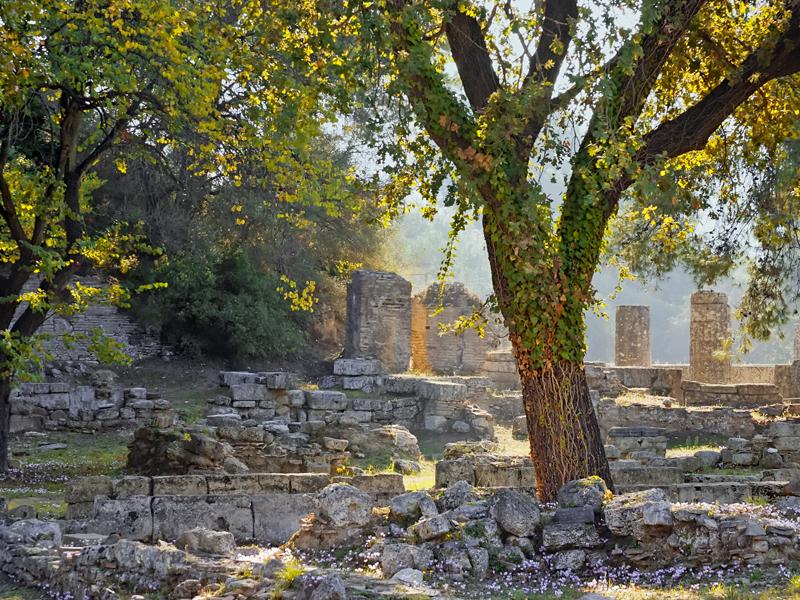
Olympia was never a city. It is a sanctuary in a river valley under a pine-covered hill, and for three years out of every four it stood almost empty. In the fourth, for five days, it held the largest gathering in the Greek world: forty thousand people on the banks around the track, a hundred oxen on the altar, and a truce that stopped wars across Greece so everyone could get here safely.
They came for the sanctuary as much as the sport. Inside the Temple of Zeus sat Phidias’s statue of the god in gold and ivory, so vast that visitors said the roof would not hold him if he stood — one of the Seven Wonders of the ancient world. The workshop where Phidias built it has been excavated. You can walk through that too.
Olympia lies in Elis, in the north-western Peloponnese — far enough west that most visitors to Greece never reach it, and the site is quiet in a way the Acropolis has not been for a century. Going private is what makes it a day: your own minivan, an early start from your hotel, and nobody’s timetable but yours at the far end.
Prefer it unhurried? Olympia is a two-night stop on our 5-day Peloponnese & Delphi tour.
The Corinth Canal
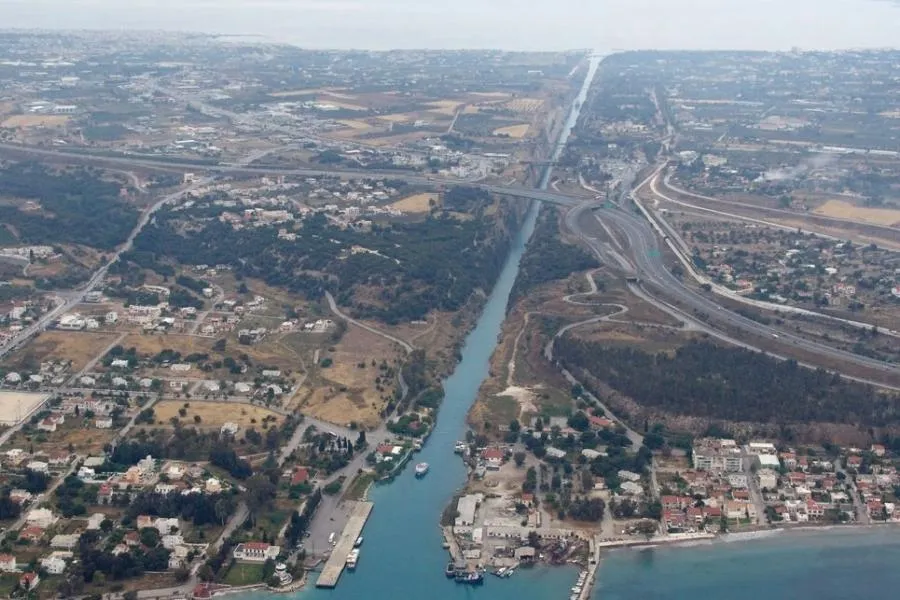
The first stop is on the bridge over the Corinth Canal, about an hour out of Athens. Six kilometres cut through solid limestone between 1881 and 1893, up to 79 metres deep and only 24 metres wide at the surface — too narrow for anything modern, so ships pass through under tow.
The idea is far older. In the 7th century BC Periander of Corinth priced a canal, decided against it, and built the Diolkos instead: a paved stone trackway across the isthmus with grooves cut into it, along which ships were hauled from one sea to the other on wheeled cradles. It worked for centuries, and sections of it survive beside the modern cut. Nero started the canal in 67 AD with six thousand Jewish prisoners and got a tenth of the way across before he died. Everyone else waited eighteen hundred years.
Ancient Olympia: the sanctuary
Olympia was a sanctuary in a river valley, empty for three years out of every four, and for five days in the fourth it held the largest gathering in the Greek world.
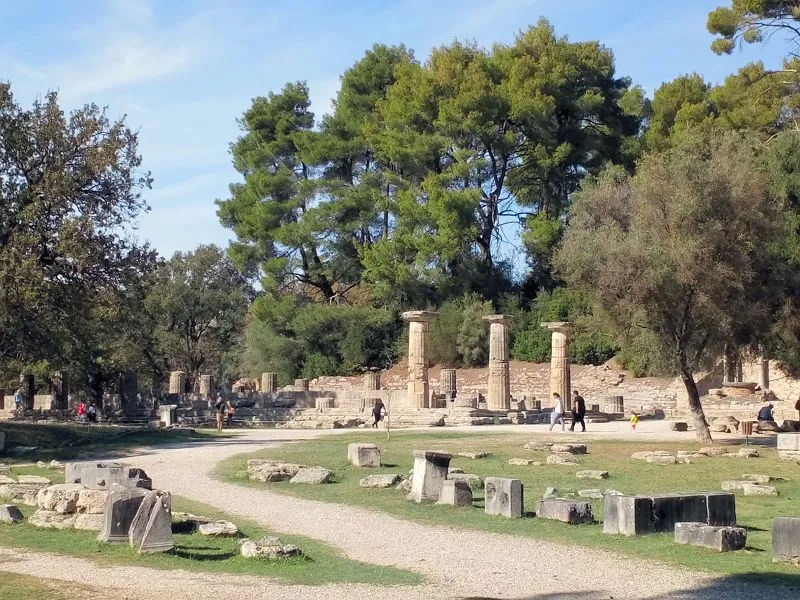
The Games began in 776 BC — that is the first victor Greek historians could name, and they dated everything else from it. The Sacred Truce guaranteed safe passage to anyone travelling to them; city-states at war with each other stopped, or paid a fine in silver to Zeus. The text was engraved on a bronze disk kept in the Temple of Hera.
The first Games had one event: the stade, a sprint of about 210 yards down the length of the track. The word for the track was stadion. That is where “stadium” comes from, and you can walk the original one — the track is still there, with the stone starting sills still set in the ground and room for forty thousand spectators on the earth banks around it.
The Temple of Zeus (470–456 BC), by the architect Libon of Elis, was the largest temple in the Peloponnese and the model of what a Doric temple should be. Inside it stood the statue of Zeus by Phidias — twelve metres of gold and ivory, seated, head nearly touching the roof — one of the Seven Wonders of the ancient world. It was taken to Constantinople in late antiquity and burned in a fire there. Nothing of it survives.
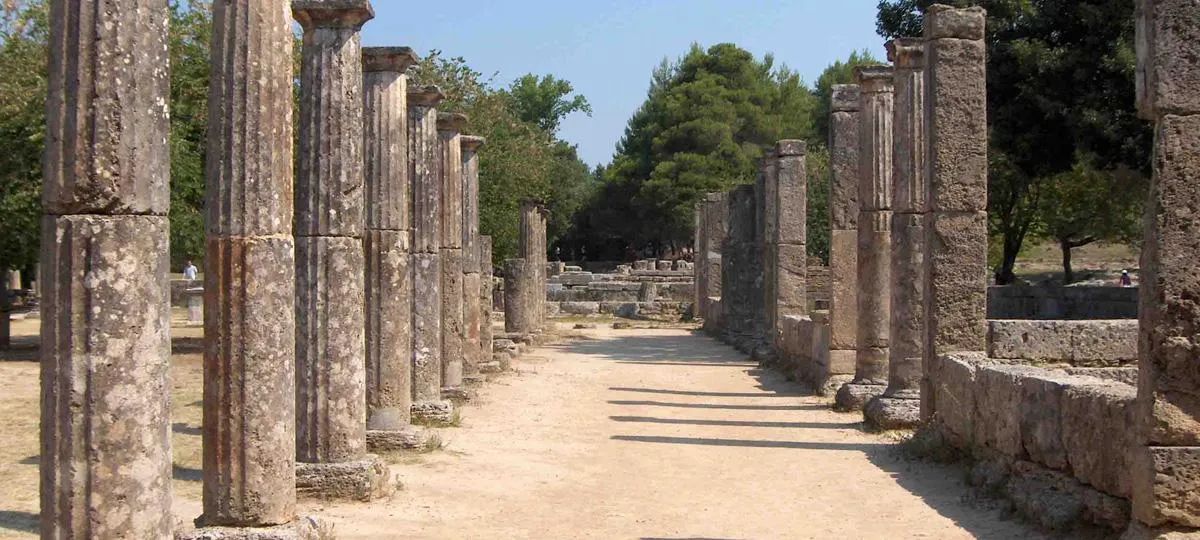
But Phidias’s workshop does. It was excavated just west of the temple, built to the same dimensions as the cella so he could work the statue at full scale. It was later turned into a church.
The Temple of Hera is older than all of it — around 600 BC, one of the oldest monumental temples in Greece. By the Roman period the Eleans had turned it into a museum for the sanctuary’s treasures.
Between the two temples stood the Altar of Zeus, and it was made of ash. Every four years a hundred oxen were sacrificed — a hecatomb — and the ash was mixed with water from the Alpheios and packed onto the altar. By the second century AD it stood seven metres high. Archaeologists dug through the layer.
The women had their own games. The Heraia, in honour of Hera, were organised by sixteen women of Elis and run in the same stadium: foot races for unmarried girls, with an olive crown for the winner, exactly as at the Olympics — from which women were barred entirely.
And the Games were not always noble. In 67 AD Nero entered the four-horse chariot race with a team of ten. He fell out during the race. He was declared the winner.
The Archaeological Museum
One of the best archaeological museums in Greece, and small enough to do properly.
The pediments of the Temple of Zeus are here, reassembled: the chariot race of Pelops on one end, the battle of Lapiths and Centaurs on the other, with Apollo standing in the middle of the chaos with his arm out, entirely calm. It is one of the great images of classical sculpture and it is in a room you can stand in.
The Hermes carrying the infant Dionysus was found in the Temple of Hera, where Pausanias said it would be, and where he attributed it to Praxiteles. The Nike of Paionios flew down from a nine-metre pillar in front of the temple.
And there is one of the most important bronze collections in the world — helmets, griffins, votives, including the helmet of Miltiades, dedicated here after Marathon with his name scratched on it.
Is the price per person or per group?
Per group. The €730 covers the whole 12-hour tour for up to 7 passengers in one minivan — it is not multiplied by the number of people.
How far is Olympia from Athens?
About 300 kilometres, and roughly three and a half hours each way on motorway. That is seven hours of driving in a twelve-hour day. It is a long day, and we would rather you knew that before booking than discover it at 7am.
Is Olympia a UNESCO World Heritage Site?
Yes, inscribed in 1989.
Can Olympia really be done in a day from Athens?
Yes, and this is how — leaving early, in a private minivan, with the pace set by you rather than a coach schedule. Twelve hours covers the drive, the Corinth Canal, the site and the museum. If you would rather not spend seven hours in the car, Olympia is a two-night stop on our 5-day Peloponnese & Delphi tour.
Where is the statue of Zeus?
Gone. Phidias’s twelve-metre gold-and-ivory Zeus — one of the Seven Wonders — was taken to Constantinople in late antiquity and destroyed in a fire. Nothing survives. What you can see is the temple it stood in and the workshop where Phidias built it, which was excavated west of the site.
Is a guide included?
No. The price covers an English-speaking driver, not a licensed guide. A licensed guide can be added for €320, for other languages, contact us. When you book a guide, remote guiding devices are included.
Are entrance fees included?
No. Entrance to the archaeological site and museum is paid on the spot.
How much walking is there?
The sanctuary is flat and spread out — an easy walk on level ground, but a lot of it, and there is very little shade. The stadium is a few minutes further on through the vaulted entrance tunnel.
When is the best time of year?
Spring and autumn. Olympia sits in a river valley and holds heat; July and August are hard work on an open site with no shade. The pine and plane trees along the Alpheios make spring particularly good here.
Included in the tour price:
- English speaking driver
- Pick-up & Drop-off service from the hotel
- Remote guiding system (“whisperers” devices) when you book guide services
- All expenses of the driver (accommodation during multi-day tours, meals, insurance)
- Tolls
- All currently applicable taxes
Not included in the tour price:
- Accommodation during multi-day tours & meals for the guests; we can assist you with these arrangements
- Entrance fees to museums & archaeological sites: these are payable on the spot, as you go
- Guide Services unless you select the extra service