
7 Day Tour Of The Peloponnese, Delphi & Meteora
4440€ / Per group up to 7 persons
Private 7-day tour from Athens to six UNESCO sites: Mycenae, Epidaurus, Bassae, Olympia, Delphi and Meteora. €4,150 per group of up to 7.
7 Days
Private tour
Up to 7 passengers
Hotel pickup & drop-off
English-speaking driver
Overview
About This Private Tour
This 7-day private tour is the fullest we offer: from Athens through the whole Peloponnese to Delphi and Meteora, visiting six UNESCO World Heritage Sites — Mycenae, Epidaurus, the Temple of Apollo Epicurius at Bassae, Ancient Olympia, Delphi and Meteora — with Ancient Corinth, Nafplio, the mountain village of Dimitsana, the Frankish castle of Chlemoutsi, Nafpaktos and Thermopylae along the way. The price is €4,440 for the whole group, not per person: up to 7 passengers, or up to 6 when a licensed guide travels with you. Accommodation, meals and entrance fees to archaeological sites are not included, though on request we can arrange a complete package with accommodation included. A licensed guide can be added for each site.
Seven days is what it takes to do the whole arc without hurrying. The route runs from the Argolid through the Arcadian mountains to Olympia, up the western coast past the best-preserved Crusader castle in Greece, across the Gulf of Corinth to the oracle at Delphi, and north to the monasteries of Meteora — with a last stop, on the way home, at the pass where Leonidas made his stand. It is the only one of our tours that reaches Chlemoutsi, and the only one that fits Bassae, Meteora and Thermopylae into a single itinerary.
Because the tour is private, nothing runs on a coach timetable. You travel with your own driver and your own minivan, and the pace is set by what you actually want to see.
Shorter versions. If seven days is more than you have, the 6-day Peloponnese, Delphi & Meteora tour covers the same Delphi-and-Meteora arc without Dimitsana, Bassae or Chlemoutsi. The 6-day Peloponnese & Delphi tour keeps Dimitsana and Bassae but ends at Hosios Loukas rather than Meteora.
Day 1 — Corinth Canal, Mycenae and Nafplio
Overnight: Nafplio
An hour out of Athens we stop at the Corinth Canal, the cut that separates mainland Greece from the Peloponnese — the city of Corinth sat astride this isthmus, holding the land route north–south and the sea route between the Aegean and the Ionian.
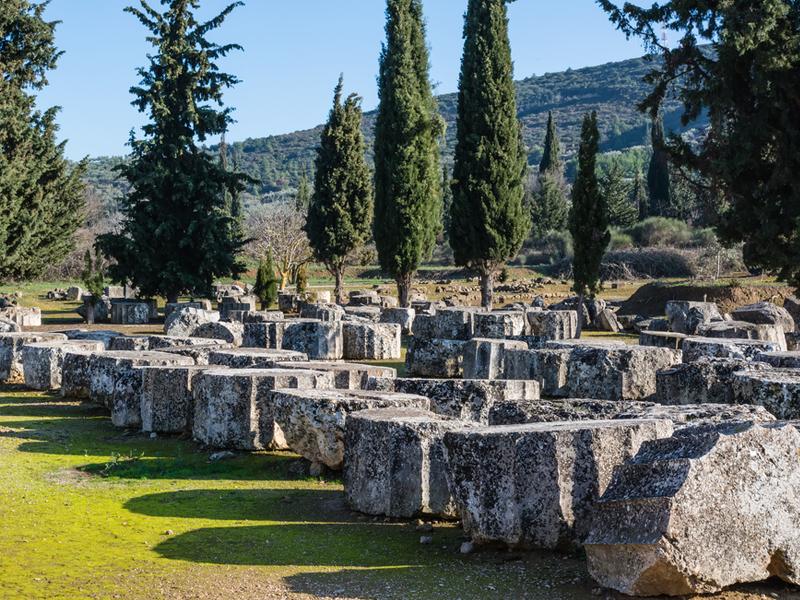
We continue to Ancient Corinth, one of the wealthiest cities of the Greek and Roman world. In the Roman Forum stand the temples, colonnades, fountains and marble-paved streets — and the bema, the raised rostrum where Saint Paul was brought to trial before the proconsul Gallio, in the mid-1st century AD. Above it all rises the citadel of Acrocorinth.
Lunch is at an award-winning family producer of extra virgin olive oil, working the local Manaki variety, with a farm-to-table tour and tasting.
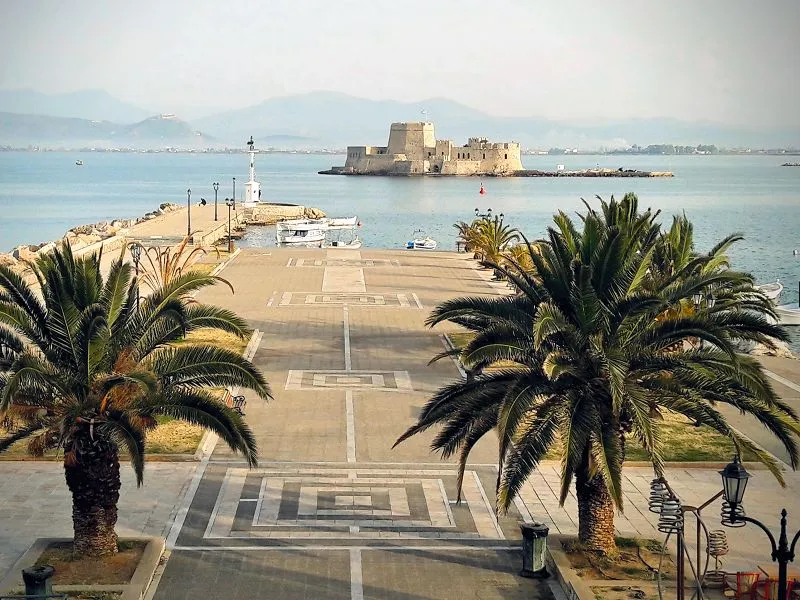
The day ends in Nafplio, the first capital of liberated Greece in 1829. The evening is yours.
Day 2 — Nafplio, Palamidi and Epidaurus
UNESCO site: Sanctuary of Asklepios at Epidaurus (1988) · Overnight: Nafplio
The morning starts with the Archaeological Museum of Nafplio, its highlight the Dendra Panoply, one of the oldest surviving suits of full body armour in the world. Then Palamidi, the Venetian fortress on the 216-metre hill above the town: eight bastions, built between 1711 and 1714 in an astonishing three years, and lost to the Ottomans in 1715, the year after they were finished.
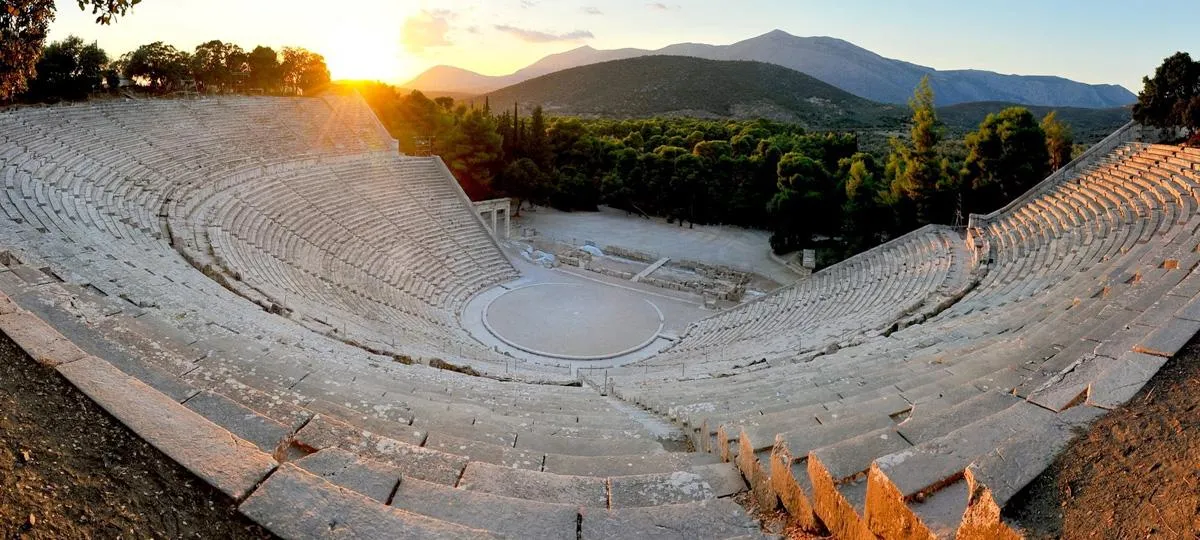
We then cross to the Argolid’s Saronic coast for a seaside lunch, before Epidaurus. The sanctuary of Asklepios was antiquity’s foremost healing centre — it includes the abaton, where pilgrims slept in the hope of a healing dream, and the theatre: 4th century BC, still in use, and with acoustics that carry an ordinary speaking voice from the orchestra to all 14,000 seats. UNESCO inscribed it in 1988.
A second night in Nafplio — well earned in a town this good.
Day 3 — Mycenae and into Arcadia
UNESCO site: Archaeological Sites of Mycenae and Tiryns (1999) · Overnight: Dimitsana
The morning belongs to Mycenae, the citadel of Agamemnon. We walk the Lion Gate, the Grave Circles where Schliemann found his gold, the palace, and the cyclopean walls — stone blocks so large that later Greeks assumed the Cyclopes had raised them. Nearby stands the Treasury of Atreus, the finest of the beehive tombs. The visit ends at the archaeological museum. UNESCO inscribed Mycenae in 1999, together with Tiryns.
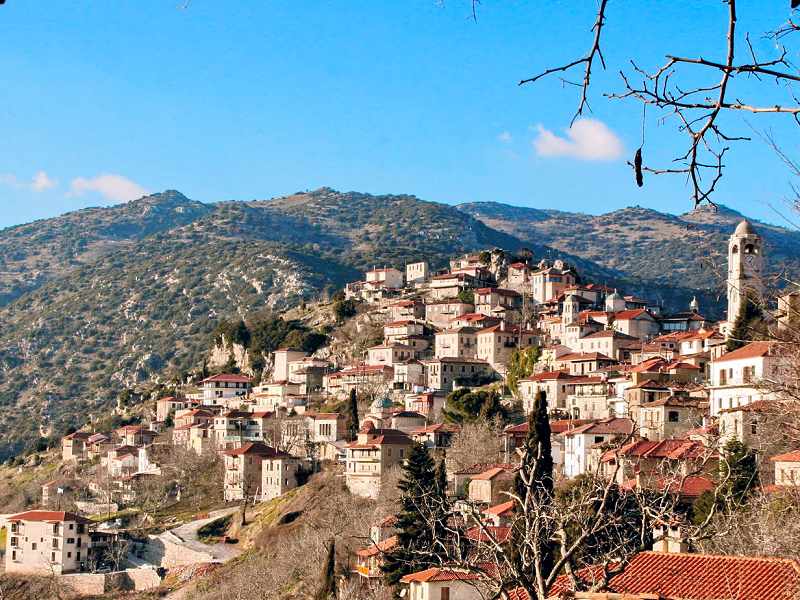
Then we head into the Arcadian mountains to Dimitsana, a stone village on a ridge above the Lousios Gorge. Here you can visit the Open-Air Water Power Museum — watermills and the gunpowder mills that armed the fighters of 1821 — or the cliff-side Prodromou Monastery, built flat into the rock face of the gorge, with an idyllic walk along the river. Overnight in the area.
Day 4 — Bassae and Ancient Olympia
UNESCO sites: Temple of Apollo Epicurius at Bassae (1986) · Archaeological Site of Olympia (1989) · Overnight: Ancient Olympia
We drive up to Bassae, at 1,130 metres. The Temple of Apollo Epicurius was built here in the late 5th century BC by Iktinos, the architect of the Parthenon, and in 1986 it became the first Greek monument ever inscribed on the UNESCO World Heritage List. (It stands under a protective tent during conservation works — fully visible from inside, but not the setting the photographs show.)
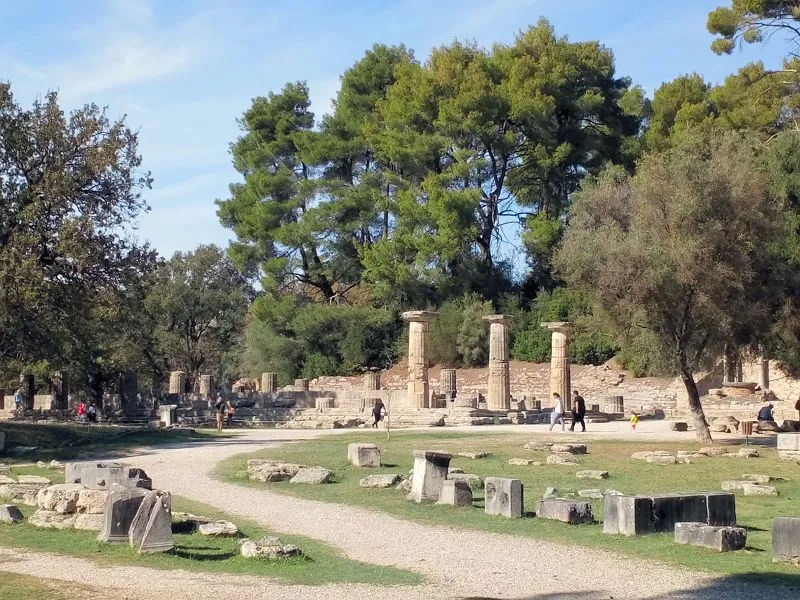
Then down to Ancient Olympia, at the meeting of the Alpheios and Kladeos rivers: the sanctuary of Zeus and the birthplace of the Olympic Games, held every four years from 776 BC until the late 4th century AD. We begin the visit today — the Temple of Zeus, the workshop of Pheidias, the Temple of Hera, the stadium — and finish it in the morning. Overnight in the area.
Day 5 — Olympia, Chlemoutsi, Nafpaktos and the road to Delphi
Overnight: Delphi
An early start to complete Ancient Olympia, including the site museum, which holds the Hermes of Praxiteles and the pediments of the Temple of Zeus.
On the way north we stop at Chlemoutsi, on a hilltop above the Ionian coast — one of the best-preserved Frankish castles in Greece, built between 1220 and 1223 by Geoffrey I of Villehardouin. Its hexagonal keep, vaulted halls and sweeping sea views make it the finest Crusader fortress in the country.
We cross the Gulf of Corinth on the Charilaos Trikoupis bridge and stop at Nafpaktos, its circular harbour still enclosed by the walls the Venetians raised in the 15th century. They called the town Lepanto: in October 1571 the Ottoman fleet sailed from this harbour to meet the Holy League out in the Gulf of Patras and was destroyed in an afternoon. From the coast the road climbs Mount Parnassos towards Delphi.
Day 6 — Delphi and north to Kalambaka
UNESCO site: Archaeological Site of Delphi (1987) · Overnight: Kalambaka
Delphi was the navel of the world, where two eagles released by Zeus from opposite ends of the earth were said to have met. For a thousand years no Greek city made a serious decision without consulting the Oracle. We walk the Sacred Way past the treasuries to the Temple of Apollo and out to the Tholos, then the museum, which holds the Charioteer — a bronze cast in 470 BC and recovered intact, his enamel eyes still in place.
In the afternoon the route turns north across Thessaly to Kalambaka, at the foot of Meteora.
Day 7 — Meteora, Thermopylae and the return to Athens
UNESCO site: Meteora (1988) · Ends: Athens
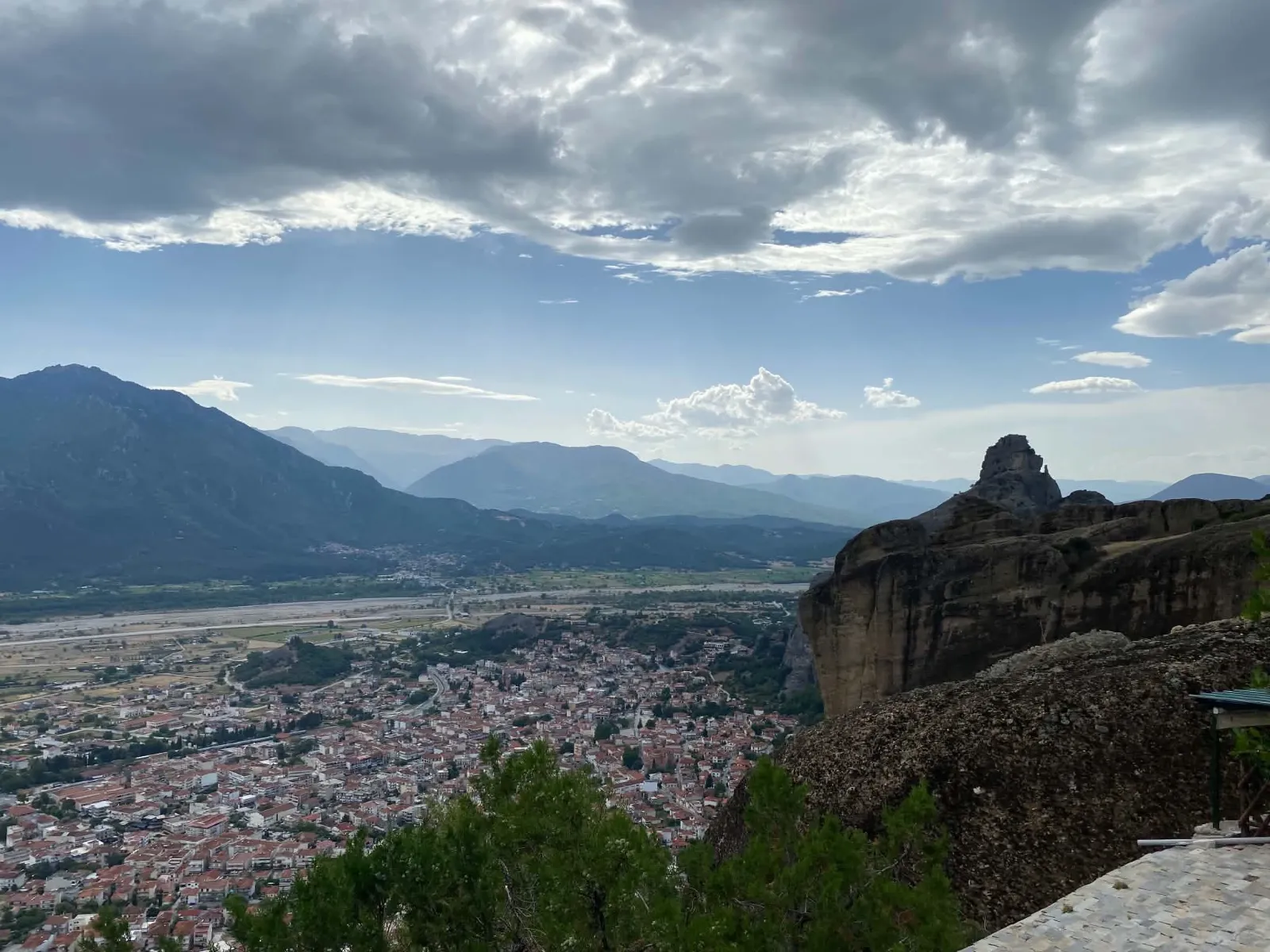
Above Kalambaka rise the pillars of Meteora — the name means suspended in the air — a field of sandstone towers standing off the Thessalian plain. From Byzantine times monks climbed them precisely because nobody else could; of the original twenty-four monasteries, six remain in operation today. It is the second monastic centre of Greece after Mount Athos, and UNESCO inscribed it in 1988 as one of only three mixed cultural-and-natural sites in the country.
On the way back to Athens we stop at Thermopylae, at the monument to Leonidas. Here in 480 BC the Spartan king and a small force of Greeks held the narrow pass against the vast Persian army of Xerxes for three days before they were overwhelmed — a defeat that has stood for courage against impossible odds ever since.
Then the last stretch back to Athens.
Is the price per person or per group?
Per group. The €4,440 covers the entire 7-day tour for up to 7 passengers travelling together in one minivan — it is not multiplied by the number of people. A group of two and a group of seven pay the same total.
Which UNESCO World Heritage Sites does this tour visit?
Six: the Archaeological Sites of Mycenae and Tiryns, the Sanctuary of Asklepios at Epidaurus, the Temple of Apollo Epicurius at Bassae, the Archaeological Site of Olympia, the Archaeological Site of Delphi, and Meteora. Ancient Corinth, Chlemoutsi Castle and Thermopylae are important historic sites but are not on the World Heritage List.
How is this different from your 6-day tours?
This is the fullest itinerary we offer. It combines almost everything from the two 6-day tours — Ancient Corinth, Dimitsana, Bassae, Delphi, Meteora and Thermopylae — and is the only tour that also reaches Chlemoutsi, the best-preserved Frankish castle in Greece. The extra day means Olympia is seen over two mornings rather than one, and nothing feels rushed. The only major site it leaves out is the monastery of Hosios Loukas, which appears on the 6-day Peloponnese & Delphi tour.
How many nights, and where?
Six nights: two in Nafplio, one in Dimitsana, one in Ancient Olympia, one in Delphi and one in Kalambaka.
Can we travel with 7 passengers and a licensed guide?
Not in one vehicle. The minivan seats 7 in total and the guide occupies one of those seats. A group of 7 can travel without a guide; a group of 6 or fewer can travel with a guide. If you are 7 and would like a guide, contact us — we can arrange a second vehicle.
Is a guide included?
No. The price includes an English-speaking driver, not a licensed guide. Licensed guides can be added per site as an extra service. The guide travels with you in the minivan and occupies one seat, so booking a guide reduces the maximum group size from 7 to 6 passengers. When you book a guide, remote guiding devices (“whisperers”) are included at no extra cost.
Is accommodation included?
Not by default. Your accommodation and meals are booked separately — though on request we can arrange a complete package with accommodation included. Either way, the driver’s own accommodation, meals and insurance for the seven days are covered in the tour price.
Are entrance fees included?
No. Entrance fees to museums and archaeological sites are paid on the spot.
Where does the tour start and end?
The tour starts and ends in Athens, with pick-up and drop-off at your hotel. Both are included in the price.
When is the best time of year?
Spring (April–June) and autumn (September–October). This route climbs to Dimitsana, Bassae at 1,130 metres, Delphi and Kalambaka, so winter can bring snow on the mountain sections. July and August are hot at the archaeological sites but bring the Epidaurus drama festival.
Included in the tour price:
- English speaking driver
- Pick-up & Drop-off service from the hotel
- Remote guiding system (“whisperers” devices) when you book guide services
- All expenses of the driver (accommodation during multi-day tours, meals, insurance)
- Tolls
- All currently applicable taxes
Not included in the tour price:
- Accommodation during multi-day tours & meals for the guests; we can assist you with these arrangements
- Entrance fees to museums & archaeological sites: these are payable on the spot, as you go
- Guide Services unless you select the extra service