
5 Day Tour Of The Peloponnese & Delphi
3.100€ / Per group up to 7 persons
Private 5-day minivan tour from Athens to five UNESCO sites: Mycenae, Epidaurus, Olympia, Delphi and Hosios Loukas. €3.100 per group of up to 7.
5 Days
Private tour
Up to 7 passengers
Hotel pickup & drop-off
English-speaking driver
Overview
About This Private Tour
Five days, five UNESCO World Heritage Sites: Mycenae, Epidaurus, Ancient Olympia, Delphi, and the Byzantine monastery of Hosios Loukas. This private tour travels by minivan from Athens through the Argolid to Olympia, then crosses the Gulf of Corinth to reach Delphi. Along the way: the Sanctuary of Zeus at Ancient Nemea, the harbour town of Nafplio, and the Venetian port of Nafpaktos. The price is €3,100 for the whole group, not per person: up to 7 passengers, or up to 6 when a licensed guide travels with you. Accommodation, meals, and site entrance fees are not included; licensed guides can be added.
If you have a sixth day, our 6-day Peloponnese & Delphi tour adds the Temple of Apollo Epicurius at Bassae, high in the Arcadian mountains and the first Greek monument to be listed by UNESCO, bringing the tour to six World Heritage Sites.
You spend one night each in Nafplio, Dimitsana, Olympia and Delphi — taking your time in the Argolid, then heading west to Olympia and across to Parnassos.
The tour is private, so the pace is yours. Your own minivan, your own driver, no group to wait for.
Day 1 — Corinth Canal, Mycenae and Nafplio
UNESCO site: Archaeological Site of Mycenae (1999) · Overnight: Nafplio
The first stop is barely an hour from Athens: the Corinth Canal, a slot cut 79 metres down through limestone between 1882 and 1893. It marks the point where the Peloponnese begins — a viewpoint stop, not an archaeological one.
Mycenae is the first World Heritage Site of the tour. You’ll see the citadel of Agamemnon, the Lion Gate, the cyclopean walls, and the tholos tombs — beehive vaults whose span was not exceeded anywhere in Europe for the next fifteen centuries. This was the centre of the civilisation Homer immortalised, and UNESCO inscribed it in 1999.
Optional: a tasting at a Nemea winery, ten minutes away. Agiorgitiko is the local red grape variety, with Protected Designation of Origin status. Alternatively, we can incorporate a visit to the site of Ancient Nemea.
The day ends in Nafplio — a blend of Venetian, Ottoman, and neoclassical influences within just a few streets — and the first capital of the Greek state in 1829. The evening is yours.
Day 2 — Nafplio, Epidaurus and into Arcadia
UNESCO site: Sanctuary of Asklepios at Epidaurus (1988) · Overnight: Dimitsana
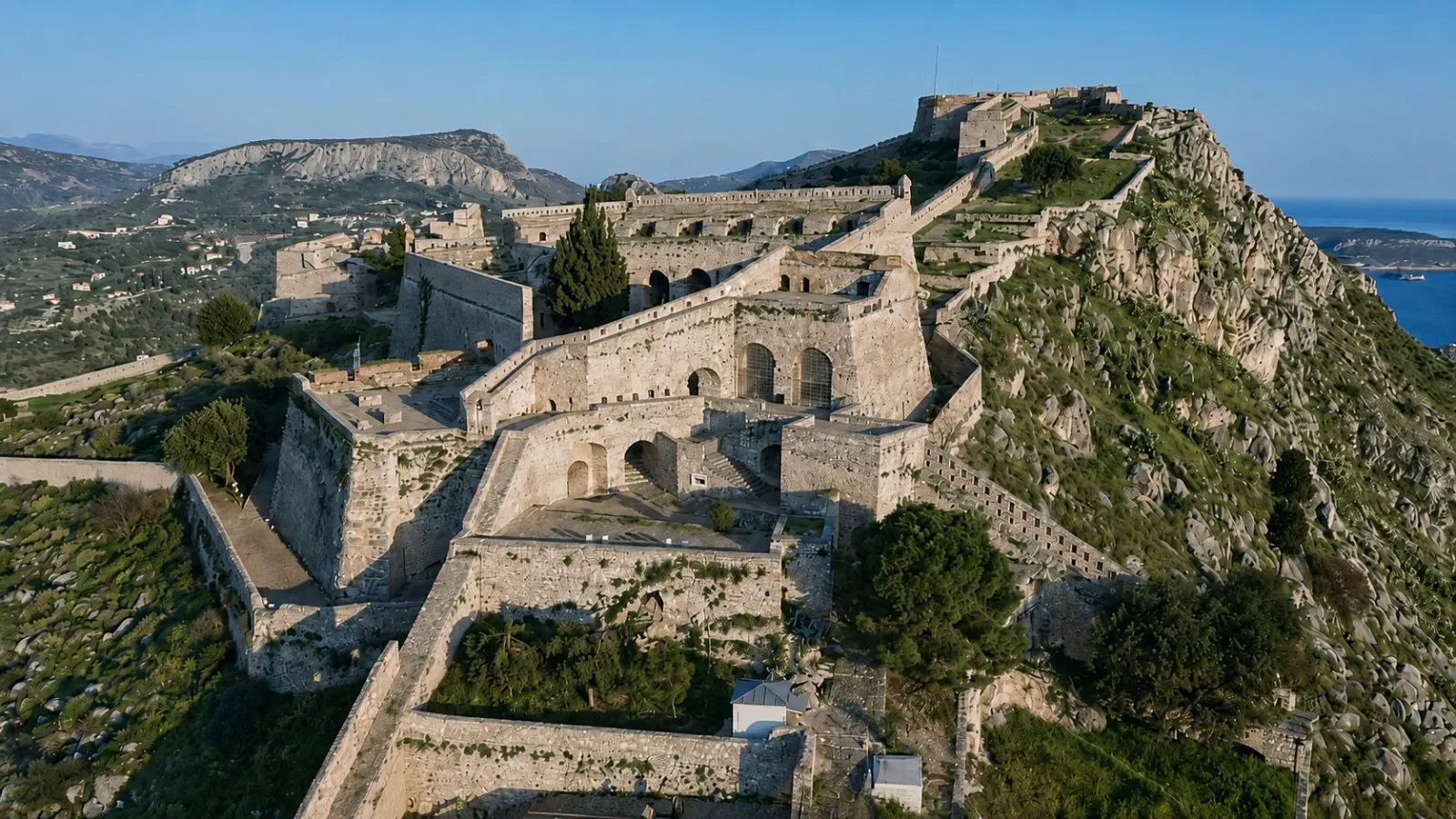
The Archaeological Museum first, then Palamidi — eight bastions built by Venetian engineers between 1711 and 1714, and lost to the Ottomans in 1715, the year after their completion. There are 857 steps up, not the 999 of legend, and there is also a road.
Epidaurus was antiquity’s foremost healing sanctuary; patients slept in the abaton and told the priests their dreams. What survives best is the theatre — dating to the 4th century BC, with fourteen thousand seats, and acoustics that still carry a coin dropped in the orchestra to the last row.
Optional: an ouzo distillery, or an olive press at nearby Lygourio.
In the early afternoon, the road turns inland and climbs. Dimitsana — with its stone houses along a ridge above a gorge — is where we spend the night.
Day 3 — Dimitsana, the Lousios Gorge and on to Olympia
Overnight: Ancient Olympia
A guided walk through Dimitsana’s Open-Air Water Power Museum — watermills, a tannery, and the gunpowder mills that supplied the fighters of 1821 from this one village.
Below runs the Lousios Gorge, and the Prodromou Monastery is built flat into its cliff, with wooden balconies extending out over the drop. The riverside walk down to it is among the best short hikes in the Peloponnese.
Lunch at a traditional farm, then west to Ancient Olympia.
Day 4 — Ancient Olympia, Nafpaktos and the road to Delphi
UNESCO site: Archaeological Site of Olympia (1989) · Overnight: Delphi
The morning at Ancient Olympia: the stadium where the Games were held every four years from 776 BC to the late 4th century AD, the Temple of Zeus, and the workshop where Pheidias built the chryselephantine statue that was one of the Seven Wonders of the Ancient World. The museum holds the Hermes of Praxiteles and the pediments of the Temple of Zeus.
In the afternoon, we cross the Gulf of Corinth on the Charilaos Trikoupis bridge — a 2.9 km cable-stayed span, opened in 2004 — and stop at Nafpaktos, whose small Venetian harbour still sits inside its medieval walls. The town gave its name to the battle of Lepanto: in 1571, the Ottoman fleet lay at anchor here and sailed west into the Gulf of Patras to meet the Holy League. The battle ended in an afternoon.
From the coast, the road climbs Mount Parnassos to Delphi.
Day 5 — Delphi, Hosios Loukas and the return to Athens
UNESCO sites: Archaeological Site of Delphi (1987) · Hosios Loukas (1990) · Ends: Athens
Delphi was the omphalos — the navel of the world, where two eagles released by Zeus from opposite ends of the earth were said to have met. For a thousand years, no Greek city made a serious decision without consulting the Pythia, and the treasuries along the Sacred Way were built from thank offerings. We walk up past them to the Temple of Apollo and then out to the Tholos on its terrace below.
The museum holds the Charioteer: cast in 470 BC, buried by a landslide, and recovered intact with his enamel eyes still in place.
On the way back, we stop at Hosios Loukas, on the slopes of Mount Helicon — the fifth World Heritage Site of the tour. Founded in the early 10th century by the hermit Loukas of Steiris, who died in 953 and is buried in the crypt, it holds the best-preserved mosaic programme of the Macedonian Renaissance in Greece. UNESCO inscribed it in 1990 with Daphni and Nea Moni of Chios; it is the largest of the three.
Then back to Athens.
Is the price per person or per group?
Per group. The €3,100 covers the entire 5-day tour for up to 7 passengers in one minivan — it is not multiplied by the number of people. A group of two and a group of seven pay the same total.
Which UNESCO World Heritage Sites does this tour visit?
Five: the Archaeological Site of Mycenae (Day 1), the Sanctuary of Asklepios at Epidaurus (Day 2), the Archaeological Site of Olympia (Day 4), the Archaeological Site of Delphi and the monastery of Hosios Loukas (both Day 5). Hosios Loukas was inscribed in 1990 as part of the Monasteries of Daphni, Hosios Loukas and Nea Moni of Chios.
What is the difference between the 5-day and the 6-day Peloponnese & Delphi tour?
One site and one day. The 6-day tour is the same route plus the Temple of Apollo Epicurius at Bassae — a 5th-century BC temple designed by the architect of the Parthenon, situated at an altitude of 1,130 metres in the Arcadian mountains and the first Greek monument ever inscribed on the UNESCO World Heritage List. This brings the total to six World Heritage Sites. The difference in price is €620.
Does this tour visit Ancient Corinth?
No. We stop at the Corinth Canal on Day 1 for the view, but not at the archaeological site of Ancient Corinth, which is a separate half-day tour from Athens. If you want both, please let us know and we can look at a tailor-made version of the program.
Where do we sleep?
Four nights: Nafplio, Dimitsana, Ancient Olympia and Delphi. Accommodation is not included, but we are happy to help you with the arrangements.
Is a guide included in the price?
No. The price includes an English-speaking driver, not a licensed guide. Licensed guides can be added for the first day in the Peloponnese, the second day, at Olympia and at Delphi.
Is accommodation included?
No. Your accommodation, meals and any optional activities are not included and must be booked separately. The driver’s own accommodation, meals, and insurance are covered by the tour price.
Are entrance fees included?
No. Entrance fees to museums and archaeological sites are paid on the spot at each location.
Where does the tour start and end?
Athens, with pick-up and drop-off at your hotel. Both are included.
How many people can join?
Up to 7 passengers in one private minivan, or 6 passengers if guides are added. For larger parties, contact us for a tailor-made arrangement.
When is the best time of year?
Spring (April–June) and autumn (September–October) are the most comfortable seasons. The route climbs to Dimitsana and Delphi, so winter can bring snow to the Arcadian and Parnassos sections. July and August are hot at the sites but also bring the Epidaurus drama festival.
Included in the tour price:
- English speaking driver
- Pick-up & Drop-off service from the hotel
- All expenses of the driver
- Complimentary bottled water
- All currently applicable taxes
Not included in the tour price:
- Gratuities: these are at the clients’ discretion
- Entrance fees to museums & archaeological sites
- Guide Services unless you select the extra service