Monemvasia
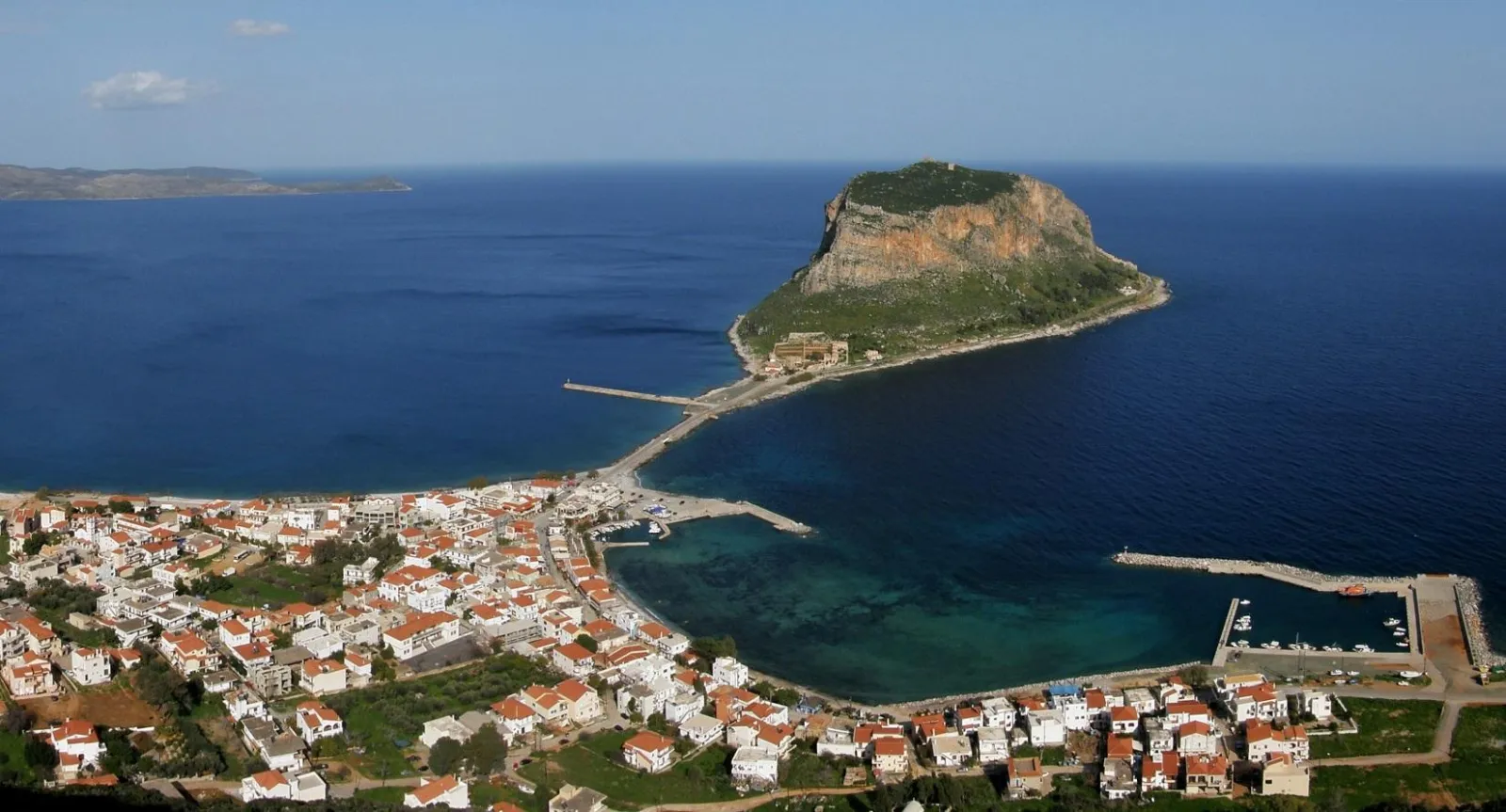
Monemvasia is a fortified medieval town built into the flank of a rock that rises straight out of the sea off the east coast of Laconia. A single causeway, about 200 metres long, connects it to the mainland — and that is where the name comes from: moni emvasis, “single entrance”. Nothing about the place has changed much since. Cars stop at the gate, and everything beyond it is walked.
Monemvasia is one of our private transfer destinations from Athens, the airport and Piraeus.
See transfer route from Athens Airport to Monemvasia →
See transfer route from Piraeus to Monemvasia →
The rock and the single entrance
The rock was part of the mainland until an earthquake separated it in antiquity. The town was founded in the sixth century by people from Laconia moving to defensible ground, and its geography did the rest: one causeway, one gate, walls that run along the only approach. It was among the most difficult places in Greece to take by force, and it changed hands by siege, treaty and starvation rather than by assault — Byzantine, Frankish, Venetian, Ottoman, Venetian again, Ottoman again, and finally Greek in 1821, when it was one of the first towns freed in the War of Independence.
The lower town
The lower town is where people still live. It is a single main lane with stone houses on either side, running the length of the rock beneath the cliff, with narrow stepped alleys climbing off it. There is no room for vehicles and no room for expansion, so the town has kept its medieval footprint entirely.
At its centre is the square and the church of Christos Elkomenos, the cathedral of Monemvasia, facing out to sea. Many of the houses have been restored as small hotels and guesthouses, which is why the town is inhabited rather than preserved as a monument.
The upper town and Agia Sofia
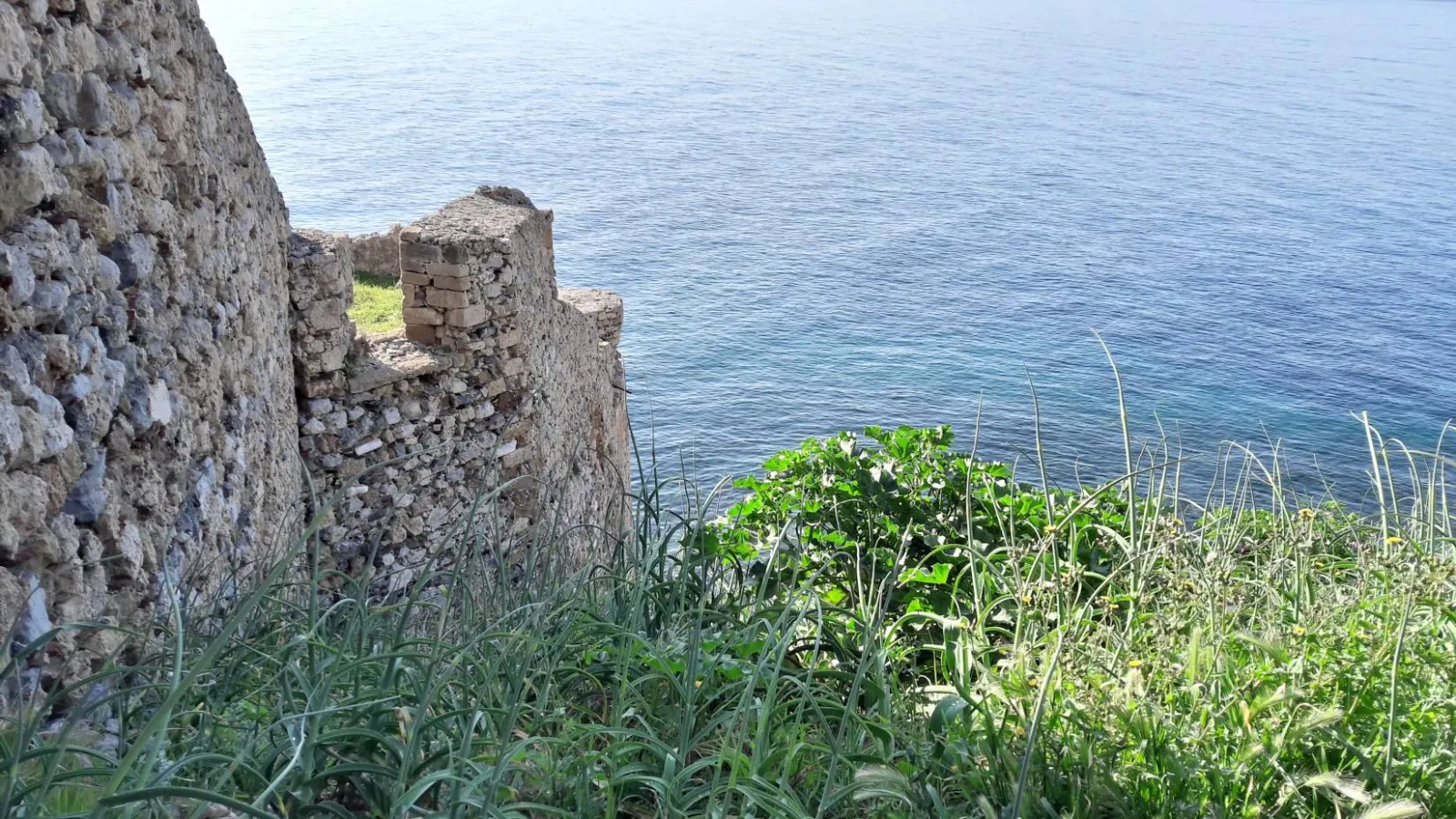
A steep path climbs from the lower town to the plateau on top of the rock. The upper town was once the larger of the two, home to the garrison and the wealthy, and is now a ruined field of walls, cisterns and foundations spread across the summit.
The church of Agia Sofia stands at the cliff edge, built in the twelfth century and still largely intact. The climb takes around twenty to thirty minutes and there is no shade on the way, but the view over the Myrtoan Sea from the top is the reason most people make it.
Malmsey wine
The Latin form of the town’s name, Malvasia, travelled with the sweet wine that was shipped from its harbour through the Middle Ages. Venetian merchants carried it across Europe, where the name followed it into English as Malmsey — one of the few English words that is, in origin, a Greek place name.
Yannis Ritsos
The poet Yannis Ritsos was born in Monemvasia in 1909 and is buried here. His house stands just outside the gate, and the town appears throughout his work. For Greek visitors this is often the reason to come; for everyone else it is worth knowing that the place has a literature as well as a fortress.
Visiting Monemvasia
| Driving time from Athens | 4 hours to 4 hours 45 minutes |
| From Athens Airport | 4 hours 20 minutes to 5 hours |
| How long you need | Half a day for the lower town; a full day, or a night, to include the upper town |
| Getting around | On foot only. Vehicles stop at the gate |
| Best time to visit | April–June and September–October. The rock holds heat in midsummer |
| What to wear | The lanes are cobbled and the climb to the upper town is steep and unshaded — proper shoes matter more here than at most sites |